On Being Neuro-atypical
Ever since being diagnosed with Nonverbal Learning Disability (NVLD) in my early 50s, I’ve been living inside a peculiar strangeness. I’ve had to learn that what had constituted my ongoing experience of day-to-day reality for decades, what I’d previously considered to be normality, had, in fact, been steadily determined by a chronic neurological condition. Finding out that my perceptions have been filtered through a disability destabilizes my confidence in what I thought I knew about the past and how to navigate the present. I no longer trust my sense of reality. What feels normal in terms of emotional affect remains the same—I didn’t trust my external environment as a child and I still don’t—but now I’m aware that the deep neural pathways that have been carved are the result of my brain being damaged. While the exact cause hasn’t been determined, most neuropsychologists believe that it results from early damage to the right cerebral hemisphere of the brain. As a very young child, I had two severe falls that had my head smashing against concrete once and ice the other time. Whether or not these occurrences caused the disability is impossible to discern, but the neuropsychologist who gave me the diagnosis credited NVLD as the culprit for my chronic depression, generalized anxiety disorder (GAD), and OCD. My years of substance abuse. Since my diagnosis over a decade ago, I’ve continually read about NVLD and periodically check online to learn of new research discoveries—there are few—but I’ve also discerned that some parts of my mental framework can’t be accounted for by this disability. Parts of my experience don’t correspond with NVLD.
Everything shifted only a few weeks ago. I’d started Brian Massumi’s Thought in the Act: Passages in the Ecology of Experience and came across this passage:
`There was very little difference in meaning,’ says autistic Daina Krumins, `between the children next to the lake that I was playing with and the turtle sitting on the log. It seems,’ she continues, `that when most people think of something being alive, they really mean, human.’
Krumin’s remarks gave me pause because I’ve always felt that everything is sentient, not simply turtles, birds or people. Ordinary objects, too. Each of the several pens on this desk, for instance, the different days of the week, the individual shingles on the garage roof below, the shadow made over it by the trees—each of these things has its own nature, personality if you will, each desires to continue existing as itself. Nothing I’d come across in researching NVLD mentioned this sort of perception. If this mode of perception—what some psychologists call “Object Personification”—isn’t an attribute of NVLD, why did I think of the world this way? I started searching online and reading books to discern if it’s common to autism? Yes, repeatedly testimonials from autistic people describe their perception that objects have feelings. This may sound strange, perhaps even disingenuous, but I never gave this situation much thought. The sense that the world almost hums with sentience has been a bedrock of my experience. Weirder, perhaps, I’ve never wondered whether everyone else shared this feeling. It just seemed natural. Let me put it like this: unless there’s wildfire smoke in the air, I don’t think about breathing; similarly, until it was pointed out to me that so-called neurotypical people don’t perceive the world as being animate, I didn’t think much about objects being alive because this had been the way the world appeared since I was a child.
Here’s Donna Williams, from Somebody Somewhere: Breaking Free from the World of Autism:
“Everything had its own, if limited, volition. Whether a thing was stationary or movable depended more on the thing’s readiness to move than on the person’s decision to move it. Statements like `it won’t budge’ only confirmed this assumed reality. It had never occurred to me to ask myself how objects knew or felt, nor was I interested. For me, it had been an unquestioned assumption.”
Though I disagree with Williams’s use of the word assumption. I don’t assume that objects, animals, the Prayer plant behind me or my son playing video games in the next room have sentience: I know that, for each of these beings, consciousness (and the will to continue as a conscious being) is innate to their existences. That said, people, animals, likely trees care whether you acknowledge their awareness of themselves as autonomous beings; most objects that I’ve encountered, however, aren’t particularly concerned whether you recognize this primordial facet of their existence.
After my original suspicion that I may have ASD, I read several books and numerous psychology articles on autism and have come to realize that I’m very definitely on the spectrum. My auto-immune disorder, meltdowns, obsessions, sensitivity to sounds, the desire for limited social engagement, the life-long craving for solitude, tactile hallucinations, germophobia—all of these are common traits of autism. My stimming, manifested in both annoying physical movement and also my continuous inventions of nonsense words that I repeat aloud all day. The anguish even minor change provokes. The angry faces I see around me that aren’t really angry. I’m not easy to live with, by any means.
When I spoke to my psychiatrist last week (I see him for clinical depression and Generalized Anxiety), I mentioned my suspicions about ASD, and to clarify things, informed him that the Eiffel Tower tourist trinket he had on a nearby shelf was positioned too close to another of his keepsakes, a statue of a lighthouse. The glittery Eiffel Tower, one of millions from Paris, had, in fact, a strong dislike for the lighthouse. He kept typing as I told him this, asked a few questions, and then said, yes, it would appear as if I’ve had ASD, most likely for all of my life, and that depression, anxiety, various maladaptive behaviors and OCD are comorbidities.
In his article “Treatment Issues with High-Functioning Adolescents and Adults with Autism,” Gary B. Mesibov quotes J.S., a young man with autism who says of his experience: “I needed an orientation manual for extraterrestrials. Being autistic does not mean being inhuman. But it does mean being alien.’” My partner of twenty years, the artist Amy Snider, has frequently, described me in precisely this way: I’m an alien, she’s told me. The more I study how other autistic people experience the world, the more intricately I grasp my distance from neurotypical behavior, expectations, and ordinary experience.
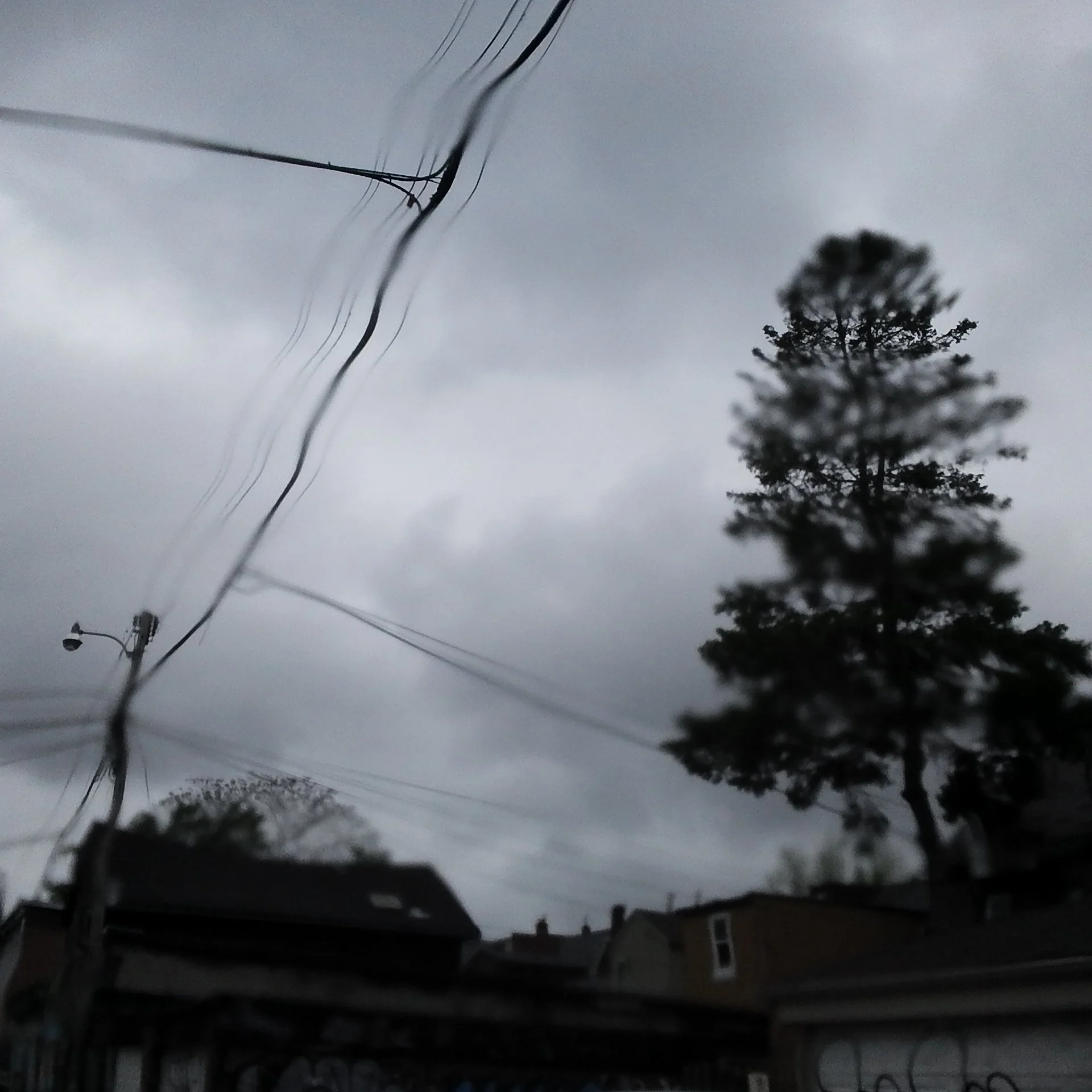
The final photograph that accompanies this post, taken in Toronto, embodies something of how things seem to me. The various electrical lines, the lamp-post, trees and clouds vibrate with their own being—a blur of entangled sensibilities, yet each distinct. And I know this sounds absurd, even to me, but were I to print a few Polaroid copies of this image, even though they would be identical, for all purposes concerned, each separate print would have its own separate form of being in the world. It’s readily apparent that this mode of thinking corresponds with some components of the philosophical school of Object-oriented Ontology (OOO). I’ll pick up this topic in a future blog post. But before then, I’m going to examine affective empathy.