
(An Elegaic Conversation)
For Dave Reynolds
Remember how long you have been putting off these things, and how often you received an opportunity from the gods and yet have not used it. You must now at last perceive of what kind of universe you are a part, and the true nature of the lord of the universe of which your being is a part, and how a limit of time is fixed for you, which if you do not use for clearing away the clouds from your mind, it will go and you will go, and it will never return.
Marcus Aurelius, Meditations, II, 4.
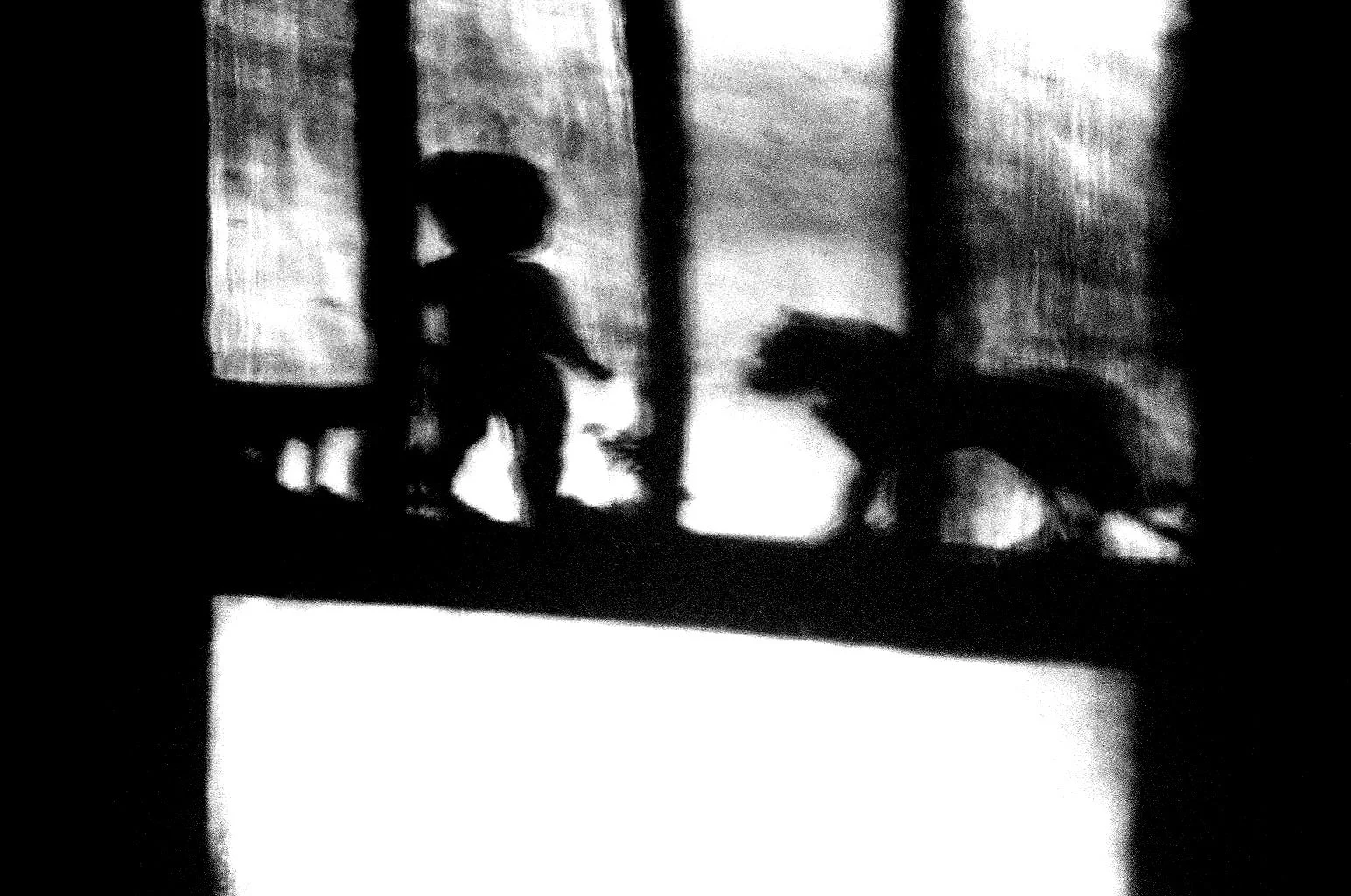
The accompanying image is from Len Carey’s series Nothing Remembers the Continuous
The following conversation took place electronically during the late-summer of 2022 between the journalist and art commentator Grant Stonehouse and mixed-media artist Len Carey. Portions of the exchange have been reconstructed from the imagination.
Grant Stonehouse: How is your health?
Len Carey: They didn’t use to ask questions like that one: how is your health?
GS: Everyone’s getting older. I guess now’s your turn.
LC: Fair enough. I now have reasons for not trusting my body like I once did. On the other hand, there’s this lovely sense of virtue in consuming organic blueberries, sleepless kale, and the purest of clear tequilas. But my memory’s imprecise in ways it’s never been before.
GS: What do you mean?
LC: I once could trust that when I started a project that would take a couple of years, the person who finished it could unhesitatingly recall how it felt to begin the whole thing, from idea to notes to practice. Now I’m several different people, few of whom I can remember. What worries me (to be clearer, what almost deranges me with fury and fear) is: what if everyone my age is experiencing this deterioration but won’t admit it? I mean: we’re stuck on a planet run primarily by damaged people way past their sixties and what if pretty well everyone who’s middle-aged (or older) is screwing up, but they’re unwilling to make the appropriate adjustments?
GS: I always loved when interviewers describe the location in which the interview took place. Communicating with you over email, I can’t do that. When you look around, what do you see?
LC: There’s some birds fighting over the dead bugs in the radiator grill of the SUV parked way too close to this window. Sam Shepard’s Day Out of Days lying face down on the floor. A plastic Australopithecus Mommy beside the shaving mirror. It’s almost dark and there’s the most beautiful thing anyone can see: the word VACANCY spelled out in thin, orange letters. Neon’s hue of disastrous perfection. The mountains are disappearing. I must be in a motel.
GS: So, you’re on holiday.
LC: More or less, though many would say that people like me are always on holiday.
GS: If you’re in a motel now, could you describe your usual workspace?
LC: I once fell in love with a Mondrian exhibit. His studio in New York must have been like the sound of a match striking. There was hardly anything there: floor, walls—almost nothing but open space. What I remember best is the wooden stool he made. It was the sort you’d stand on to water plants. Except there were no plants. He hated green. When he was on a train, he’d turn his head away from the window, just to avoid green. If you looked at the stool closely, you’d notice how many angles and rectangles he’d used. I regret that I don’t think as precisely as he did. There’s only one stool in the world like his. Or was. Who knows where things end up? I don’t have that purity. When I work, I’ll often put a movie on: recently I kept replaying Andrei Rublev. A brilliant movie about colour versus history and how one of them always wins. Just before I came here, I kept shuffling pictures I’d taken of Rembrandt’s painting of Aristotle contemplating a bust of Homer: he looks like an aging biker who’s suddenly struck it rich. There are numerous toy soldiers, some antique, quite a few of them trying to find the right target. Many aim at the door. There’s something I should probably throw out, just in case it’s poisoning the air: the feathers and claws I cut from a Blackburnian warbler that flew into a window just over a decade ago. What’s left is in a Zip-lock bag, taped against the wall. A fossil mosasaur`s tooth inside a bus station diner coffee cup I`ve kept from London, Ontario. I often listen to music repetitively: some Lou Reed, Tim Hecker’s Ravedeath, 1972. Certain tracks from David Bowie’s Heathen.
GS: Are you listening to music now?
LC: A mixture of Einstürzende Neubauten and some watered-down Mozart. When I’m thinking about Rothko, which is often, I pay attention to Morton Feldman. His music for Rothko’s chapel. The lovely migration of musicians trying to learn from painters who sometimes made claims about poetry. I guess this puts the pin through my thorax. An hour ago, Laurie Anderson’s Homeland. But that’s a different story.
GS: What did you do today?
LC: I hiked up Ha Ling Peak. Showed me like a bitch how old I’m getting. I almost gave up several times. Until today, I hadn’t realized how mountains reach into you. Up on the top the wind kept everyone low; it was so fierce. There was this couple who’d passed me on their way up, and, as we exchanged cameras on the peak, I could sense more than a dash of schadenfreude.
GS: You were envious?
LC: Of course. I always think in terms of life’s arithmetic. If they’re lucky, they’ll have 50 more years of hiking, whereas I have considerably fewer, maybe 10-15 tops. That’s if everything goes to plan. But I don’t only envy their youth. After they made the hike, stood on the peak, they then lay back against the mountain in a slight cavity, which protected them from the wind. Held hands. Maybe closed their eyes as they lay side by side. I’ve never learned how to do this. Lie down in the open. Let a moment leave me alone. Can’t be done. Nope. And then of course they passed me while going down the mountain. It was a pleasure to see them later that night on a patio restaurant on Main Street; so I sent them an anonymous bottle of wine.
GS: I know this question is usually kept until the end, but what are you working on?
LC: Why be so abrupt? Wouldn’t it make sense to ask what the trail conditions were like, what kind of wine everyone was drinking that night? Anonymous details matter. What I’m working on just now keeps changing, but it goes something like this: there’s a train, heading to Normandy, one of those trains that has cabinets on one side, an unsteady hallway on the other. There are three people sitting across from you who keep shifting because of the hand-held camera: Ai Weiwei, Marcel Proust, and Heinrich Himmler; and each of them notices that you’re reading Peter Longerich’s biography of the Reichsführer. I imagine that this book will be the last one written on Himmler. Meanwhile this old guy keeps showing up all the time: at every station he’s knocking at the door: he’s got to find his cat and let him outside so he can look at the seagulls. Do you know anything about that?
GS: Why have public spaces suddenly become important to you? Nothing you’ve done before involved park benches, or those truncated seascapes on a playing field, for instance.
LS: Your use of the word “suddenly.” How wonderful. Thank you. My best friend stole the coffee cup I referred to earlier from a bus station diner. Gave it to me for Christmas. Maybe one day I’ll give it back to him, suddenly.
GS: Your earlier work was meant to be displayed indoors. Burning (minus) 4 involved miniatures within refrigerators. Your recent work with park benches is subject to accidents. One was partially destroyed because of two dogs fighting. At least the video camera recorded it all.
LC: Let the benches be attacked by jackals riding werewolves, if need be. It’s part of the show. Those fridges, btw, had been placed in different places to weather first. Each for two years. And Montana is different from what Florida or Amsterdam can do. I’ll let you in on a secret: when Sven Nykvist died, one of his fans took a crow bar to three phone booths in downtown Stockholm. Imagine that: a city with phone booths. Wish she’d gone after one of my fridges. I’m also working on a series that begins like this: the audience sees something of Mondrian’s, and then an axe cuts through the canvas from behind. It doesn’t take long. You’d be surprised at how varied the reactions are. Everything after follows from that.
GS: But why video now? Why holographs? Almost all of your work’s been painting, photography, the occasional chalk board.
LC: Beuys did chalkboards first. Whatever I did was in homage. Painting isolates what happens when you try to put things together, but there’s something about incoherence that’s hard to manage with static images. A master like Leon Golub can do it, but I’m not a master. You want to take on different kinds of deliberate evasion, chance, and obsession, but certain things remain problematic. These days I prefer video because video’s so accurate and also it’s so spiritually crude. There’s a part of me that just can’t wake up in the morning, so I spend the rest of the day with a part of me saying yes, no, yes, to what consciousness not so much ignores, as misses entirely. It’s like there’s this stream in the back of my head that keeps falling asleep. My work is precisely the adult’s attempt to restore not so much the previous innocence of childhood as its sudden and oceanic incoherence. Video embodies something of that. Have you seen any of Joseph Cornell’s movies?
GS: Cornell made movies?
LC: It’s mostly Cornell addicts who know about them, or go to where they were made. He often spliced together bits from incommensurate films or followed pigeons around a fountain. Park benches were like Alice’s looking glass to him. The man was perfect because he was both ahead of and behind his time, and likely couldn’t have told the difference between them.
GS: Who are the artists you’ve been thinking about lately?
LC: Depends what you mean by either demarcation. Anselm Kiefer gives me more chances than I deserve, but because I don’t speak German memory, I’m limited to imagining what remains the very second his hand has left the canvas, or put down the blow torch. Christian Boltanski. Ori Gersht. A Caspar David Friedrich painting I don’t remember ever having seen. Vermeer, always. Some time ago, the Met held a retrospective of Robert Frank’s The Americans. Spent my time in front of his streetcar in New Orleans shot. Somehow he gave breathing room in that photo to every important movement since 1904. I’ve been trying to do something like that these days, what Frank did: meld a distanced realism with an odd kind of political expressionism, but in an almost-forgetful-but-now-I-remember-it kind of way.
GS: I understand Vermeer, and Frank, but Friedrich?
LC: Friedrich understands what it means for a moment to pass. He’s utterly different from Monet, a painter who also thought about moments; but for him, it’s a calibrated trembling. The colours vibrate all on their own: they’re meant for the receptive human eye. Monet wants to know the instant in terms of now. But Friedrich looks at the second that happens after that original moment. His colours are diffuse, enormous, almost unfamiliar, and in their refusal to be nailed down, they have no lasting interest in how they’re perceived. He understands that we have no means either of comprehending or articulating what it means to be faced with these things.
GS: Some of your recent work features someone named Dave Reynolds.
LC: There’s an historian with the same name, but I don’t mean him. Dave was a boy I knew when my family lived in England when I was young. We went to school together. He had a scar on his upper lip that embarrassed him terribly. Everything shrugs its shoulders. I discovered by accident that he’d killed himself after serving in the Falklands War. I’ve tried hard to learn what exactly happened, but no one at the other end in England will answer.
GS: I know who Jizchak Löwy is because I saw his image flicker in the Kafka museum in Prague. Löwy keeps showing up in your recent work. Can you tell us about him?
LC: Not very much. He was one of Kafka’s most carefully chosen friends. He was a Yiddish actor whom Kafka`s father derided. He lived in Paris and then returned to Poland, thinking maybe about his problems. Ended up back in Warszawa. Let me email you a photograph: in it, there’s a glass of wine, a box of bread across from an empty chair. I took this picture in a hotel in downtown Warszawa, after having taken a cab to the Umschlagplatz Monument—the taking away place—which is the last open space that Löwy would have seen before being transported to Treblinka. If he hadn’t been Kafka’s friend, you and I wouldn’t be talking about him now. On the monument, there’s a list of first names. Abigail to Zygmunt. Until I took the picture, I hadn’t realized how irony becomes a meaningless constant that argues with guilt. Apart from a cluster of sentences in Kafka’s diaries, the closest I would get to him was getting out of the cab that early evening and crossing the street to Umschlagplatz. Later in the restaurant, I continued this kind of false day-dreaming. I imagined him in the present, wanted him to choose something from the wine list, decide on his favourite cheese; but, as I started to pass the bread to him, the dish struck a thick and now suddenly dirty plastic partition between us with a smack, and he disappeared: it’s more than a little self-serving, but I hallucinate often.
Last Monday I watched A Film Unfinished, a documentary that contains sections of a movie the Nazis made in the Warszawa ghetto to show how disgusting they are: Jews—and here’s how they should make you feel. That the images are unbearable is the smallest part of what happens. You become suspicious of every motive regarding what it means to watch this movie. You’re not a victim, nor a perpetrator, nor a witness. Almost everyone in front of you is going to end up at Treblinka. A child dances with the hope for money. There it is, everything, on a street that can’t ever have happened. I need to go over this movie slowly, with a magnifying glass, as it were. Perhaps if I do this often enough, I’ll see Löwy. Or what Korczak might have seen.
GS: What other documentaries do you return to?
LC: Herzog once made a movie in a cave. It hasn’t been disturbed for over 30,000 years. He’s there because of the cave paintings. And he discovers that a late-Paleolithic artist started a rendition of some kind of animal, let’s call it a reindeer or a bear or some other creature that’s extinct, and for reasons we’ll never know, this artist didn’t finish it . . . but 5,000 years later, someone new came along and completed the painting. Gave the previous artist a kind of high five. And then, along comes Werner. Imagine somebody in ancient Sumer writing part of a poem, and then, someone else picks up those very threads last year (maybe you if you write poetry), moves from one stanza to the next and decides to finish the poem. Could you do it? Everything staggers. What within could help you try to do something like that? Such joy.
Grant Stonehouse has written widely on visual artists. He has a forthcoming article (in the journal November) on the semiotics of taxidermy in the work of assemblage and installation artists such as Ed Keinholz.
Len Carey works in photography and mixed media and has exhibited in Canada, The Netherlands and the Czech Republic. He divides his time between Field, British Columbia and Amsterdam. A Selected Writings is appearing shortly.
This interview is fictional. While Grant Stonehouse and Len Carey are imagined, Dave Reynolds was a friend of the author; he shouldn’t be confused with the historian of the same name.
This interview is from 10:10.