
Autistic people are often drawn to poetry—reading it, writing it and especially enjoy reading it aloud. Psychologists suggest that this fascination embodies echolalia (the love of repeating certain sounds) and an affinity for poetry is often accompanied by the autistic penchant for list-making and other forms of verbal collection. Although I received a late-life diagnosis and only recently began learning of the disorder’s complexity—my OCD, chronic depression and anxiety, autoimmune disease, periods of substance abuse are comorbidities of autism—I’ve been writing poetry since my early teens. I haven’t forgotten my original amazement at what words can do when I came across Dylan Thomas—how can anyone resist “altar-wise by owl-light”—and the jubilance of e.e. cummings; likely every poem I write is partially the attempt to get back to what it felt like to encounter their work. My first book was composed of lyric poetry, but I soon lost the desire to focus on subjective experience, and writing poems that most often honed themselves into a single voice began to feel too narrow. I don’t trust emotion for one thing, and my own autobiography doesn’t interest me much. I prefer to think that a poem is less like a vessel for containing the arresting moment than it is, as Patricia Hampl says regarding the lyric essay, an “instrument” that explores the unsteadiness of reality. A new poem contains these lines:
Pass the baton but keep your hand
in the popcorn, movie’s not over at least to
the naked eye. I lost faith. Ferret it out, dammit,
the squeaking chair. The bathtub melting in the snow.
The disappointed photograph floating in the pond. Who
were you talking to in the playground?
Lines like these don’t manifest a privileged anecdote; instead, they channel a joyful malaise of voices, none of which takes precedence over another. Here are a few more lines from a different poem:
The second chance depends on the toy
toy inside the display case. It’s what never
leaves you. Look outside. A derelict diorama
of composted cars the colour of a crow’s egg.
The assemblage of nearly incommensurate statements loosely cemented by internal association favours the fragment. For many years, my initial impulse towards the traditional lyric had vanished.
*
But then, after I had the worst autistic meltdown I’ve ever experienced—they come over you (almost) by surprise and tear everything up, the feeling is sickening—my partner of nearly eighteen years responded by saying that’s it. No more. Divorce must come and the decision’s irrevocable. There was more to it than her finally having enough of this torpedoed psyche of mine, certainly, but living with an autistic person can’t be easy. And now I find myself in late middle-age cast aside again. I’ve never been able to sustain a romantic partnership. After I described my ultimately failed relationships to my psychotherapist, she held herself quite still, sought out my gaze that generally avoided hers, and told me that eventually, very often after many years, there had come a time that I just wasn’t good enough for my romantic partners—those with whom I’ve tried to build life-long relationships. Message loud and clear. I’ve spent hundreds of hours with psychiatrists, psychologists and counselors, and none of them has offered me such a succinct, merciful, and astute insight to the way things have been.
I’m still adrift even after a few months after my partner’s declaration. Have lost several kilos and the night is punishing the way nights can be when your life’s controlled by another person. I walk a lot—around the nearby lake mostly and have rediscovered park benches—it’s the only thing that takes the edge off and during one of these walks I returned to the idea of writing lyric poetry.
Take an observation, drill into it, and then reshape it. Make a poem move inward rather than scatter into whatever’s external to a poem. Be attentive not only to the sound waves that bump into everything but the concision of accidental particularity. One day this past summer, mired in self-pity, grief and fear, I overheard a conversation between two elderly men that seemed to require a lyric poem:
Hang on,
you’re not allowed inside unsheltered
like that. Defiled like that. His body looked
like he should be laying in a coffin. No hair
on him at all—he looked God-awful. This was
one old man to another, his walker an orange
brown affair quietly taking in the lake. This was
yesterday, and I was the goon in the ancient
sunhat, purple gloves and binoculars, trying to shake
off tomorrow’s blood test and facts, facts, facts: I’ve become
a dead wedding ring whisperer. There’s no fire
extinguisher stashed nearby and aging’s the Rosetta
stone that doesn’t care to be stared at. It just
wants a minute—there’s so
much to carry
—July 29, 2025
A detail such as the words one aging friend was saying to another is a kind of Rosetta stone; it communicates a shared meaning, though in different languages that require deciphering.
*
Identifying key autistic traits, Donna Henderson, Sarah Wayland and Jamell White argue that “a narrow and intense focus of attention [often called monotropism] is a core feature of autistic nervous systems . . . [Monotropism includes] an ability to focus deeply on an intense interest and attention to detail” (bold in original). It’s not only that autists have the capacity to focus on details; details are fundamental to autistic experience. If so-called neurotypical people usually resort to narrative to explain themselves to themselves, or to interpret external reality, autists find themselves enmeshed in a congeries of details. Our minds are filled with a multitude of sounds and images of various instants—gestures, faces, lines of conversations from decades past, the toy octopus an American bulldog had in her mouth on a street in Golden B.C. during the fire season several years ago, a time that deposited ash on our car’s windscreen that needed to be swept off before returning to our journey. The thing is that this enormous collection of details remains a bewildering collection of disconnected fragments that don’t get translated into stories. Matthew K. Belmonte observes that “autistic neuropsychology may impair the processes subserving narrative organization. It’s therefore possible that my delight in Polaroid photography results from the way my brain is structured.
In his attempt to understand how the autistic brain manifests “local coherence’ at the expense of globalizing synthesis, the clinical psychologist Tony Attwood writes: “as an amateur photographer, I conceptualize [local coherence] as perceiving the world through a telephoto lens rather than a wide-angle lens.” Exactly. I think this is why Polaroids compel me. By its very form, a Polaroid photograph embodies a detail, a fragment that glows with its own autonomous integrity. This style of photography maintains nearly absolute particularity. They are a bathtub melting in the snow. Like all photographs they may imply that an explanatory narrative is nearby, but only at first. If you look closely you see that there’s something in a Polaroid that abjures the communal and insists on being perceived by no one.
*
And finally, an image special to me, no matter how brutal its associations may become in the near and far future. My soon-to-be ex-wife has often shown me things she thinks might make a good Polaroid. On our final family vacation, she’d gone for a walk in Galiano Island, and came across a mess of abandoned vehicles entangled in trees. You might like to see them, she offered later. I did.
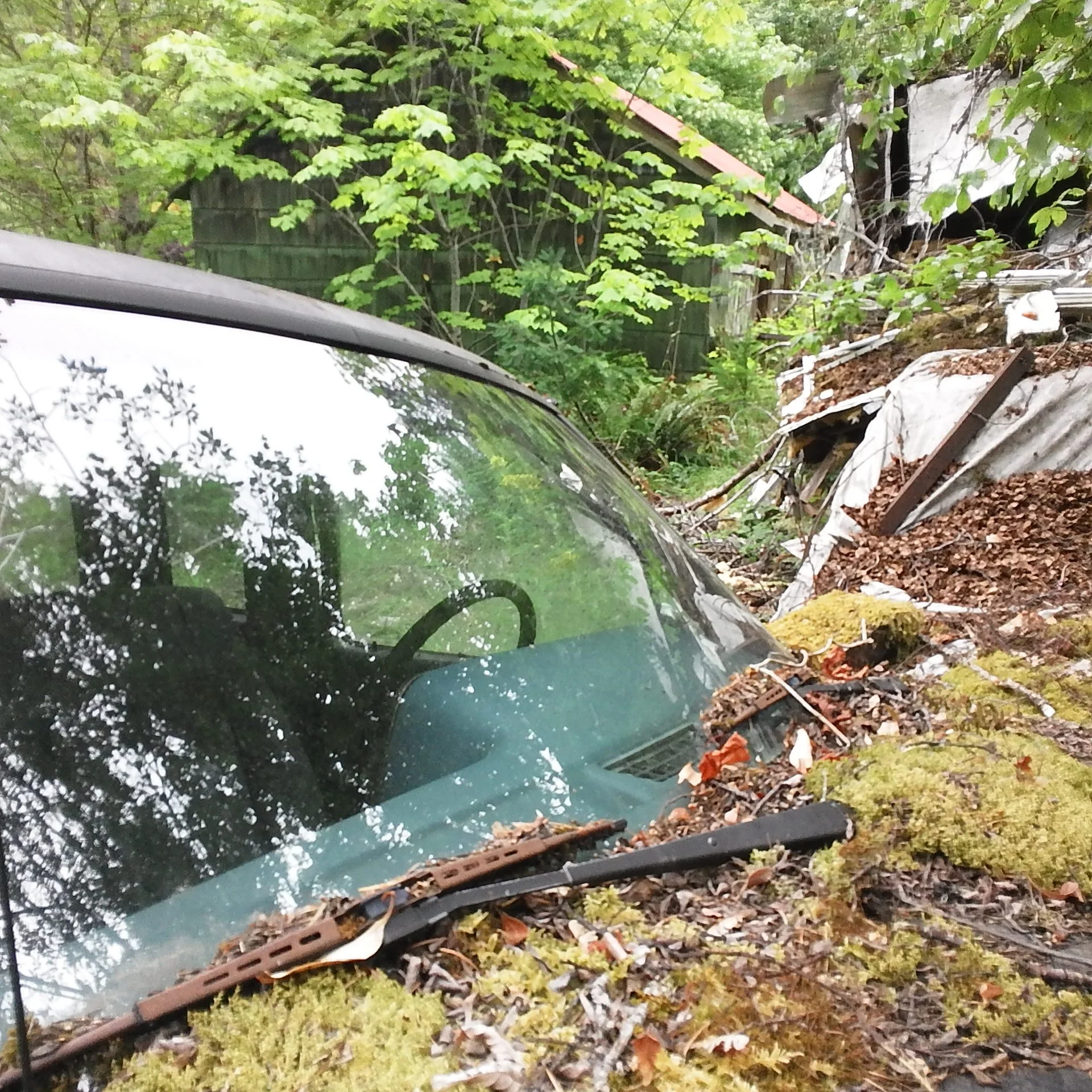
The aging life, neurodivergent or not, steadily becomes an abandoned one, acquainted with terror, and who can predict, with certainty, who will pass by to wonder where it’s been, what it has seen, and why it acted the way it did? Perhaps no one, perhaps several—it doesn’t matter much because everything is sentient, from steering wheel to fallen leaves and each manifests the enlivening indifference that forms the core of things.