
Illness is a breakdown of meaning in the ill person’s life. Because of the disruption of habits, expectations, and abilities, meaning structures are destabilized and in extreme cases the overall coherence of one’s life is destroyed.
Havi Carel, The Phenomenology of Illness
This past week I had my first appointment with an oncologist. The appointment took place at the same hospital I went to for surgery and when my catheter got blocked and I had to go to ER. Heading toward the hospital’s entrance, I wondered about the ER: how many people were waiting there and what had brought them to a place that they knew would involve hours of sitting in a crowd? I also thought of the numerous patients going into and recovering from surgery, lying in beds above the main floor that holds the Cancer Wing. Heading inside the Allan Blair Cancer Centre, the first thing you might notice is the various wigs on mannequin heads, the painting of a bison herd that includes a small, white one, the large presumably comfortable chairs. Even though my brother-in-law (a medical doctor whose specialty is internal medicine) has informed me that the pathologist’s report on the nature of the tumour excised last week is good news—the tumour hadn’t bit into the muscular wall of my bladder—I’m nervous. Fill out more forms, receive a coil-bound book titled My Journey . . . A Journal of Care, have vitals taken, and then be placed in a room to wait for the oncologist. Room 19. That all of this is new to me is logical and it also disquiets me. I realise I’ll be making many trips to this place and that this unwelcome novelty will be replaced by repeated procedures over the weeks and months of treatment. And again, I’m ashamed not to have thought much about such experiences until they happened to me.
But this shame is too simple. Shame is the right word to describe how I feel in response to neglecting thinking seriously about how illness affects other people. Years ago, for instance, I met a late-middle-aged friend of my father’s at a party. I knew her only slightly and so casually asked how she was as one does. “I have cancer,” she announced, holding my gaze. I admired her for her being forthright (my background growing up in southern Ontario inculcated in me the idea that one kept news of serious illness private), but here’s the thing: this woman speaking to me in the late 1980s instantly was jettisoned from the community of the healthy to which I belonged and became not a pariah exactly, but her medical condition seemed to me then to be the most salient thing about her. Her professional life as a teacher was over and her new identity was paramount. That it never occurred to me to think about her individual experience of cancer is what makes me feel ashamed now. I can only assume that it’s possible that my cancer diagnosis dominates the way other people perceive me now.
Connected to this newfound sense of shame—which engages my response to other people—is a sense of disappointment, and this is a disappointment with myself. While I regret smoking of course, the disappointment explicitly resides in my failure to acknowledge my own fragility. But even this is complicated. I’m an ordinary person and this means that I fall into regular patterns. Here is Havi Carel on the way most people live before they become ill:
“The healthy body is transparent, i.e. taken for granted. This transparency is the hallmark of health and normal function. We do not stop to consider it because, as long as everything is going smoothly, the body remains in the background, the vehicle through which we experience, but not the thematic focus of experience.”
Yes, I took bodily heath for granted. Yes, my body was in the background—but all around me was ample evidence that such insouciance was contrary to the facts: I had an uncle with emphysema, various neighbours developed cancer or had heart attacks. What occupies me now is the question of whether one can arrive at a realistic grasp of the tenuous nature of health before one is forced to do so. Perhaps because of my mood disorders, I’ve thought of death and decay since I was a teenager, have read numerous illness memoirs to learn more and perhaps prepare myself but I was in no way prepared for the “disruption” Carel outlines. Now I have to learn what I should have learned before. But can one do this, integrate the meaning of illness before one experiences it? I’ll never know because I no longer have a choice. Perhaps because of my ASD I’ve never really managed to perceive my life as being “coherent,” but being examined by an oncologist reduces one’s sense of self to being a raw, outwardly composed anxious patient who desperately hopes that this doctor won’t deliver more bad news. I wanted to ask her about her profession: how many of us interact with frightened people in our jobs? What is that like? What does it mean to have enormous expertise in managing the lives of those who are imploding? Be in the same room as them?
This oncologist gave off the aura of someone who could be trusted. She answered my questions, though I didn’t ask her the ones above. She gave me some confidence that my cancer was treatable though she also frankly admitted that it could have spread to other organs and so she would be ordering a CT scan. She affirmed that it was possible, even likely that the bladder cancer would reappear and this means that I’ll begin BCG treatments in less than a week’s time and have regular cystoscopies for years to come.
All this to say that I’m beginning to grasp that my old life is over; what this entails will become clearer as my treatment continues and my body is examined more intricately for ongoing and perhaps new diseases. Let me close with a brief thought to Carel’s reference to habits being disrupted. ASD has molded me in such a way that I rely on routine: I go to bed and wake early. Upon waking, I take vitamins, load up a bowl with frozen, organic fruit (think berries), and then make some coffee. The laptop is turned on so I can check the air quality and email. I then read for about an hour: starting with memoir or fiction and then moving to philosophy. A few poems. Breakfast, a brief walk to lower blood sugar. Clean my C-pap machine. If I’m not teaching that day, half an hour on an exercise bike, the same on a rowing machine. Lifting weights every two days. Then write for several hours. Then play three games of chess, make dinner, watch some TV, read some more, and finally go to bed. When I was still living with my (former) wife and my son, this routine involved interacting with them, but now that I live alone, what I’ve described is my preferred way to go through a day. Go to bed, wake up, repeat.
Now with the cancer diagnosis, I try to keep to the same routine (though I had to cease exercising for a couple of weeks post-surgery). Everything is the same but of course it’s also different in tone. It’s affect is so different. Blueberries and regular exercise might have delayed the cancer, but they didn’t stop it. The books I usually read are those that would help me teach university classes in literature and theory but they also would dovetail with my own writing. Compulsive reading remains a joy though I’m becoming much more careful with what I read. I’m reading much more with a more narrow focus: I need to understand this illness more than keeping up with contemporary novels. Cancer memoirs dominate what I read—and I won’t be teaching them. I approach Jorie Graham’s work with a new attentiveness, owing to her brilliance at depicting her own cancer treatment alongside ecological devastation. I read Carel on the phenomenology of illness rather than returning to Graham Harman and OOO. After the initial diagnosis I binge-watched Yellowjackets and From. I’m tapering off the TV these days, unsure whether I should be distracting myself or starting a series of letters to my kids. For years I couldn’t get anything published but have been fortunate more recently; yet, as I start a new book of creative non-fiction, alongside a new poetry collection, I do so with no certainty that either will ever be published. Or even completed, a thought on bad days. Habits remain as structure, though their quality of engaging a trajectory with the future is different. I know that I need to continue taking care of myself, but I don’t believe that sustaining these habits will make me safe. It was naïve to think that they would. I should have been teaching myself to get ready for this time, but I dawdled. I didn’t coast as it were, but always at the back of my head was an insistent voice that reminded me that I wasn’t taking life seriously enough. I wasn’t disciplined enough. This voice—where did it come from?—was right.
Finally, here’s a photo of the “Monument to the Unknown Bureaucrat” (Óþekkti Embættismaðurinn) in downtown Reykjavik that was sculpted by Magnús Tómasson in 1994. When I saw it with my youngest son in May I thought of Auden’s poem to the Average Citizen and enjoyed the sculpture’s open-ended treatment of going to work in a white-collar job. But now I look at the image quite differently. One of the things for which I’m most grateful is that when we were in Iceland, I had no idea I had cancer. Although both my son and I are still mourning the loss of our family as it once was, we didn’t have cancer penetrating each day. We reveled in each other’s company and the marvel of Iceland. In no way do I think the sculpture is meant to represent anything other than its name—though the volcanic block of stone around the man’s head could be either self-imposed or coming from societal expectations—but I see the representation of the man contrasting neatly with the woman walking past. Both carry bags, both are mid-step. Only for the sake of this paragraph, let me say that until now, I’ve been that flesh and blood passerby who was aware of the inevitability of illness, and the punctuality of mortality that was right there, but I largely ignored these things. I saw the frozen man and walked on. And perhaps worst of all, I gave no thought to what it would be like to be immobilized in that jagged, heavy block of stone that could be said to represent the isolation of the ill person.
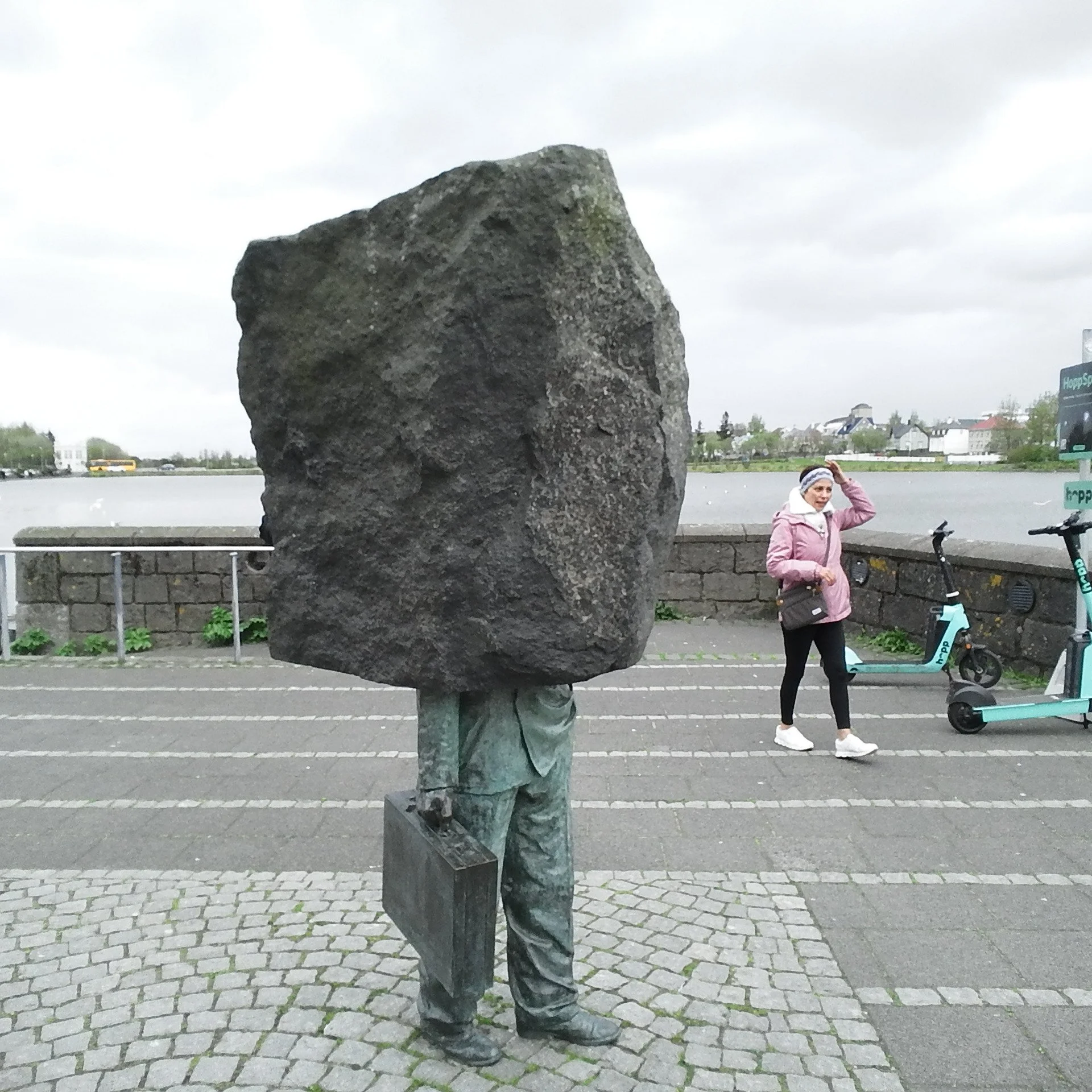
“Monument to the Unknown Bureaucrat” (Óþekkti Embættismaðurinn) in downtown Reykjavik that was sculpted by Magnús Tómasson in 1994