
On Cancer, Photography and the Anthropocene
To take a photograph is to participate in another person’s (or thing’s) mortality, vulnerability, mutability. Precisely by slicing out this moment and freezing it, all photographs testify to time’s relentless melt.
Susan Sontag, On Photography
We stared into our computer and smart phone screens so we wouldn’t have to watch our planet die all around us.
Robert William Sandford, The Anthropocene Disruption
My visions of a future I can create have been honed by the lessons of my limitations.
Audre Lourde, The Cancer Journals
Two of the images below are commonplace when one considers what it means to be alive at the onset of the Anthropocene in the twenty-first century: one photograph shows what remains after a wildfire has swept through a forest and the other indicates a shrinking glacier.[1] Both record a moment once present during July 2026 but they also summon the time over which this damage has been done: the days in which the wildfire burned; the decades over which greenhouse gases have accumulated in the atmosphere. These photos were taken during a recent trip I took to Jasper, spending five days there attempting to familiarize myself with the destruction caused by the 2024 fire. Upon arriving in the town, I had no difficulty recognizing numerous businesses and landmarks I’d seen over the past seventeen years when I’d visited as a tourist who enjoyed hiking in the mountains, though much of the western part of Jasper was in the process of being rebuilt: concrete foundations and wooden structures were everywhere.[2] There were also empty gaps beyond the sidewalks where houses once existed. I bought some groceries from the same supermarket in which I’d shopped many times before and then headed south to the Sunwapta Lodge, pausing only a few km south on the Iceway Parkway to photograph the burned trees.
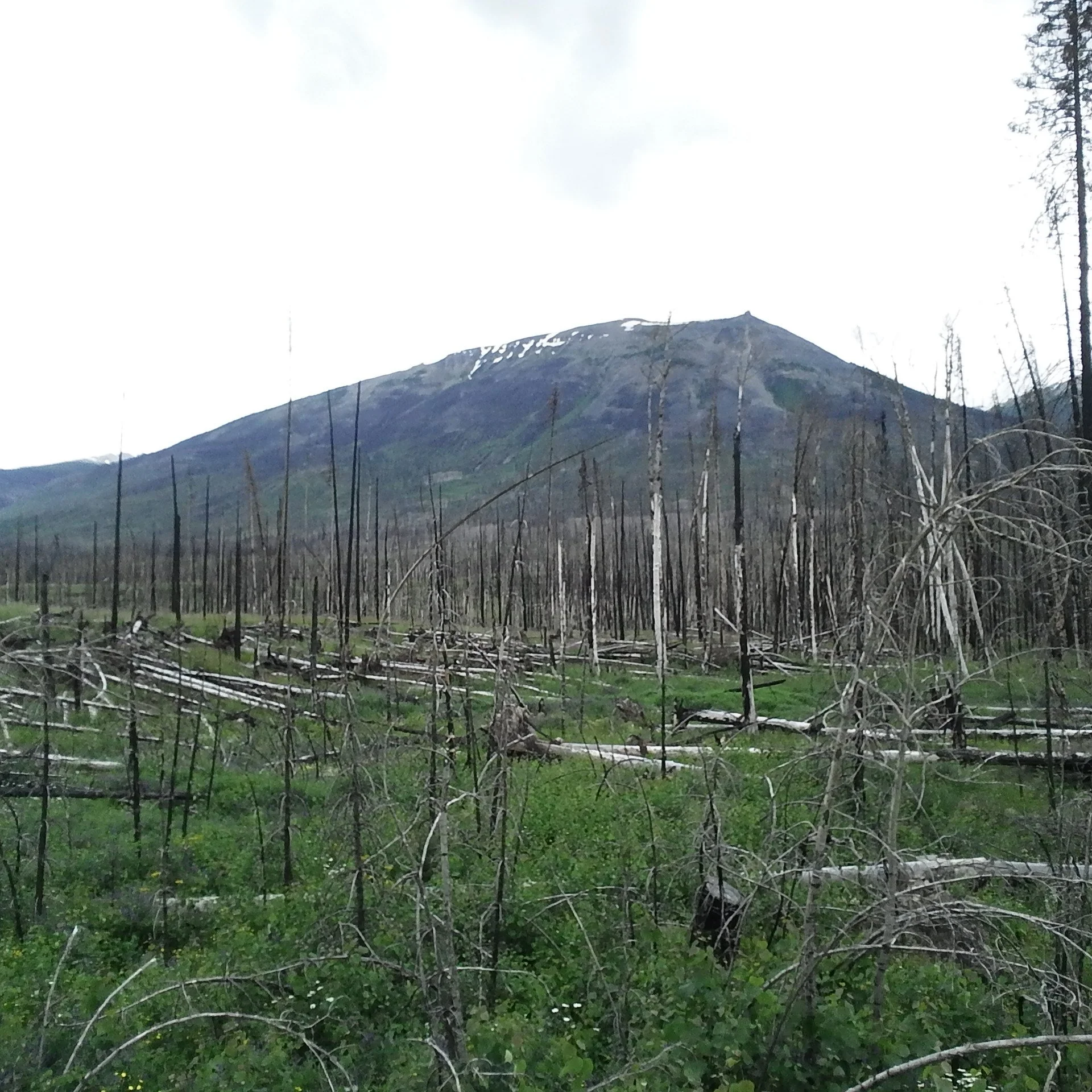
Forest south of Jasper, July 2026
Living in southern Saskatchewan, I’ve become accustomed to waking up to orange skies filled with particulate during late spring and throughout the summer—this is the precise manner in which most people living here encounter the Anthropocene intruding into daily life. We in the south part of the province are fortunate: further north, communities have been demolished by forest fires. Having smoked cigarettes for decades, I’m particularly vulnerable to wildfire smoke; when the Air Quality Index is five or above, I spend the day indoors beside an air purifier and wear a mask when I need to go outdoors. My addiction to cigarettes has taught me about denial. Of course, I knew the health risks when I smoked but reacted by telling myself they wouldn’t affect me. That I was able to break the addiction suggests to me that it’s possible for a person to break away from denial and face reality in a small but determined way. That it took me many attempts over several years to quit underscores how difficult it is for the mind to grasp that actions have consequences. I’m currently being treated for bladder cancer; it’s possible that my smoking (and exposure to wildfire smoke) caused this disease even though I quit almost twenty years ago.
Being able to break an addiction suggests to me that people can alter their behaviour in response to global warming and other forms of ecological disaster; though the comparison between an individual’s efforts to alter a habit and a society’s potential readjustment of its economy and cultural mores is a false one for obvious reasons. To name merely one: the choice to improve one’s health often provides nearly immediate benefits, but the need to curtail emissions requires thinking about future generations. As I write, wildfires are devastating northern Ontario, France and Spain; were the impossible to occur and we immediately reduce our emissions as much as scientists advise, the results wouldn’t be evident for decades. Europe and North America will continue to burn. If it’s true that it’s impossible in 2026 for most of us to deny the anthropogenic causes of global warming, loss of species diversity, and the acidification of the oceans, it’s also true that this knowledge remains strangely abstract for most people. It doesn’t seem to have become as real to us as the fear of cancer is now to me. Here is Christa Wolf, who, although writing about cancer in Parting from Phantoms, goes to the core of addiction, cognitive dissonance and denial:
Did I yield to the suggestion that there is a special connection between this particular disease and `society’—that is, all of us? If so, I would then have to ask myself what I regard as the prominent feature of our society. One striking feature, it seems to me, is a certain addictive behavior on the part of many people, a compulsion to activities that we can’t give up—or, conversely, an inability to do things we ought to do—even if we know and read and hear and admit everyday that our behavior is suicidal, and even if many experts and scientists compare us to lemmings. What stands between our insights and our actions?
Regarding our reluctance to join insight with action pertaining to climate change, George Marshall is blunt: “The bottom line is that we don’t accept climate change because we wish to avoid the anxiety it generates and the deep change it requires.” Attempting to offset my contributions to global warming, I drive a Prius, give donations to environmental charities, and generally only purchase groceries that come from North America. Yet, I also flew to Iceland with my youngest son earlier this year, buy frozen edamame that is shipped from China. I went through three tanks of gasoline on the trip to Alberta and I own GICs with the Royal Bank, an institution that refuses to divest from fossil fuels. Most of us are to blame to varying degrees. That said, to complicate matters, I’m also aware that none of the puny actions I perform to lessen my carbon footprint matter in a world that continuously flies fighter jets, opens up wildlife preserves to Big Oil. Builds larger SUVs. More important than my recognition that my individual efforts are rendered immaterial by governments and politics over which I have no control is the likelihood that it is already too late to curtail horrendous climate instability. Admitting that we “have lost the fight to slow the effects of climate disruption,” Robert William Sandford, the Global Water Futures Chair in Water and Climate Security at the United Nations University Institute for Water, observes: “we face a very real prospect that within this century, humanity, in full knowledge of what we are doing and the risks associated with our actions, will irreversibly degrade the conditions that support life on the only planet we have.” I can’t imagine anyone being capable of fully grasping the severity of our situation, but that doesn’t mean that we shouldn’t think about the Anthropocene. If I’m a mess of contradictions, low-grade hypocrisy, and addicted to comfort, I think that these personal traits (while presumably important in political terms) themselves intimate some of the many ways we are starting to discern the Anthropocene. It makes sense to think about the various intricacies of our collective and individual failure to respond as we should, certainly, though it’s revealing to examine how complicated our position is as inhabitants of the early twenty-first century. Consider the photograph of the burned forest, a bare trace of an inferno that was years in the making; consider the technology that constructed the camera that generated the physical Polaroid print. Both the fire and camera intimate the Anthropocene. The photograph itself implicitly requires a viewer to recognize not only the history of forest management in Canada alongside the technological complexity of the camera which had its genesis in the nineteenth century (with its emphasis on progress) but it also juxtaposes two incommensurate realities: an elderly man with serious illness parks a car south of Jasper one early afternoon and points a viewfinder at burned trees that were a local manifestation of climate change, a phenomena that defies the individual’s existential response to time. Here is Timothy Morton:
[Y]ou can’t see global warming. You would have to occupy some high-dimensional space to see it unfolding explicitly. Think of a daffodil. A daffodil flower is a three-dimensional map of an algorithm executed by DNA and RNA in the daffodil’s genome. . . . Now think of global warming. We only see snapshots of what is actually a very complex set of algorithms executing themselves in high-dimensional space. . . As it is, I only see brief patches of this gigantic object as it intersects with my world.
For Morton, global warming is a “hyper-object,” a massive, multi-dimensional force that blurs the future and the past. And global warming is only one component of the Anthropocene; plastic and nuclear waste will outlast any social formation we can imagine existing or declining in the next few centuries. That Morton relies upon the metaphor of the “snapshot” is germane to this essay that contains photographs: I mean to use them as a means to integrate the necessity for us to think about the Anthropocene from the vantage point of a singular, limited moment of perception without ignoring the impossibility of grasping what it means to be alive now. It is a perverse paradox that limited human perception, writ large, has resulted in creating a new geologic period that is beyond human comprehension and worse, that this terrible transformation has caused and will continue to cause the destruction of so many innocent and unsuspecting lifeforms.
There are certain facts: Big Oil has known about the perils of fossil fuels for decades and has lobbied strenuously to maintain its power and profits; as I sit here, I’m relieved not to be fitted with the catheter I wore all last week because of the surgical removal of a tumour from my bladder—the development of plastic aided in the surgery itself and my recovery. One more fact, this one taken from John Vaillant’s Fireweather:
As the Penn State climate scientist Michael Mann put it: `The vast proportion of historic greenhouse gases have been emitted as by-products of the choices and activities, not of the masses of ordinary people, but rather of the wealthy minority of the world’s population […] It’s a very specific part of humanity that has created these problems.’
As someone who has benefited from air travel, plastic, and a fully stocked grocery store, I’m part of the “wealthy minority.” But I don’t fly my private jet from one state to another for a board meeting as some CEOs do. I want our society to switch to renewables, and I very rarely buy anything other than books, Polaroid film and food.[3] The shoes I was wearing while taking these pictures were purchased nearly fifteen years ago. I’m also a resident of Saskatchewan whose government prefers burning coal for electricity rather than developing wind or solar power.
Not far from the recovering forest pictured above is another gathering of burned trees, many of these fallen on a steep incline. I needed my hiking poles to climb the slope to find the ruin of a large tree slanting down from the side of the mountain. I’m autistic and autistic people often examine objects from multiple angles; we pick them up and turn them this way and that, curious about their shape and texture. I couldn’t manipulate the fallen tree, but I twisted myself around it, stood very close and underneath on two occasions over two days, taking numerous photos from various vantage points.
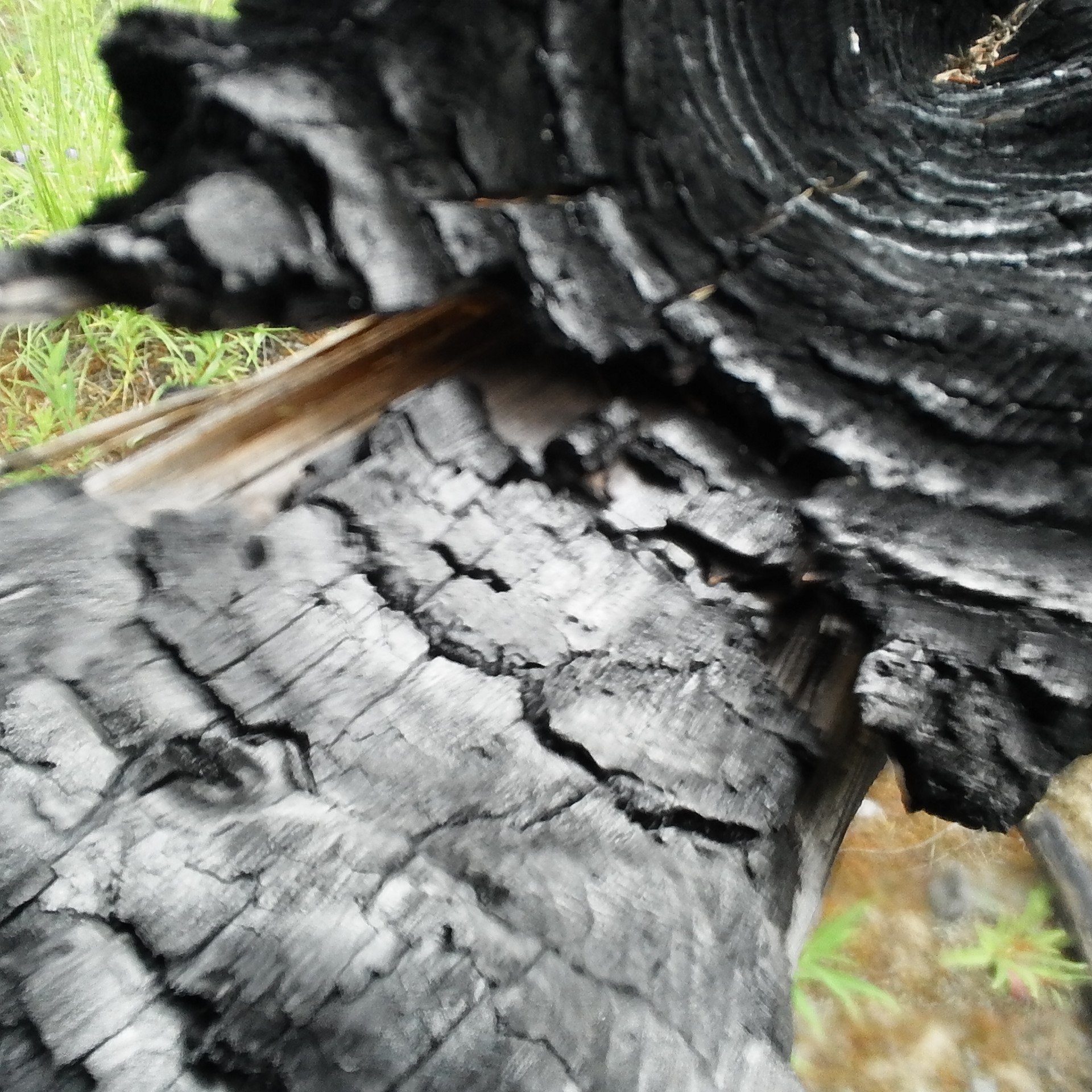
I observed the way it rested on the newly growing understory, a process Vaillant identifies as “revirescence.” Rubbed bits of charcoal between my fingers. Slid on the unsteady ground around the dead tree. Out of nearly twenty images, this one is the best composition: the foreground shimmering with a black that recalls the feathers of a raven; the hollowed-out trunk receding in diminishing circles, some of them shining like images in an ultrasound. Seen on its own, the aesthetic form of the image would likely predominate over its content, though the attentive viewer would soon discern the immediate referential source of the picture. The trace of catastrophic violence—how many animals perished and lost their homes during those days that July?—easily becomes an aesthetic object, perhaps even a beautiful one. Whether one finds this transformation jarring or irrelevant would vary with each viewer, though the predicament itself of photographing a corpse at a certain angle because it is beautiful in that precise position would seem to derive from a kind of ruthless callousness.[4] And yet, there is more to the act, I think, than an indurate response to destruction. Benjamin Swett offers that taking a photograph “represents a moment of intense and sudden love and insight for something visible in the world—for the world itself, or for life, or for one’s own self; a moment of connection that momentarily dissolves the barriers between the photographer and the things around him, outside him.” This photograph helps to examine our condition at the onset of the Anthropocene. To take the image with the intention of acquiring something from the visual field specifically to satisfy the desire to make an art object, especially perhaps when one removes it from its larger ecological background parallels the human propensity to extract something from the natural world and reshape it for our own purposes and desires. And yet, as Swett implies, one can photograph an object because of love for it and the world in which one finds oneself and the objects photographed. Put differently, photography doesn’t necessarily evoke ownership; rather, it can embody a response to the world that “dissolves the barriers” between subject and object. Or at least, this photograph can alert both the photographer and the viewer to what Jane Bennett calls “the impossible singularity of something else.” Attuned to the singularity of this one burned tree amongst a forest of others, one can perceive photographs themselves and the phenomena they render “as vivid entities not entirely reducible to the contexts in which (human) subjects set them, never entirely exhausted by their semiotics.” Neither the burned tree nor the photograph can be reduced to something that merely traffics in human discourse. If, for Bennett, refusing to turn everything into a product—whether aesthetic or economic—has progressive political implications, this photograph embodies the strangeness of the Anthropocene. The carbon stored in the trunk, the carbon that was released from the tree as it burned will persist long past this particular Polaroid image, exerting an influence on living and non-living things that is impossible to measure. And yet, the burned tree’s beauty, quoted in the photograph (as John Berger would put it) points us to the complicated recognition that, despite the destruction that surrounds us and is also heading our way, beauty remains—though savouring this beauty is inextricable from mourning.[5] The image also intimates that very often beauty in the twenty-first century embodies, if not requires, the non-human.
But we can’t stop being humans; we are always enmeshed inside and liberated by semiotics.
Central Jasper holds a firehall, a building constructed in 1936, a decade before the so-called Great Acceleration began, that point immediately following World War II in which our species began to fundamentally alter not only the biosphere, but the earth itself. To drive through Jasper, past the empty lots and new construction, past the busy restaurants and other businesses dependent upon tourism and encounter the old firehall is to glimpse a different age, but it also is to be brought back into the network of ideas and sign systems that people use to organize reality. To happen by the firehall today is to encounter situational irony: designed to fight fire, it survived the wildfire while it was incapable of protecting the town and surrounding forest. The photograph, though, expands this irony. Not only the large SUV on the left but the stream of traffic reflected in the side-mirror of my car
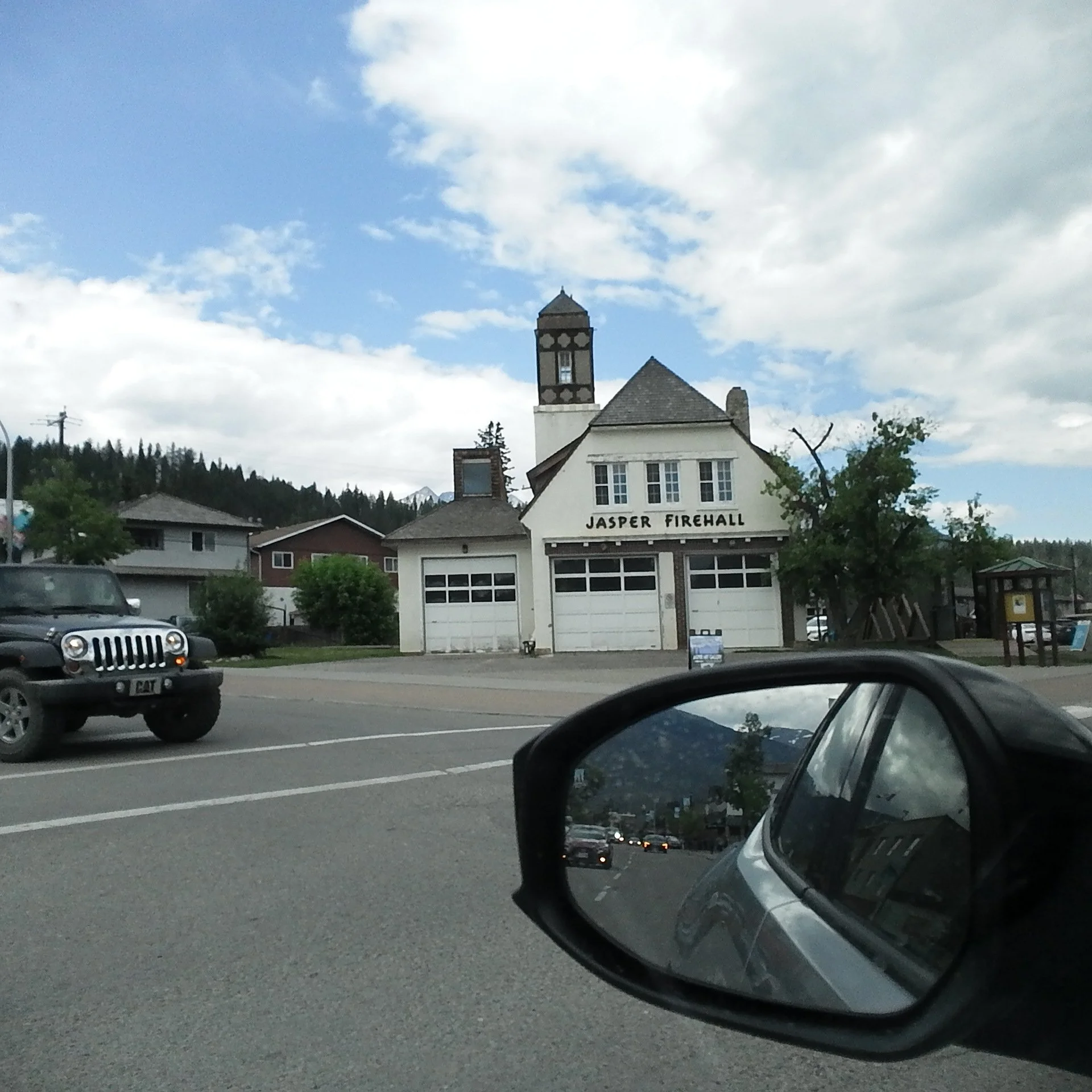
Downtown Jasper, July 2026
specifically contribute emissions that worsen global warming that the firehall was helpless against. The lines in the road, the signal light in the truck indicating the driver’s intention to turn left, the side-mirror itself—each of these objects are tools that embody the human propensity to formulate communal rules to regulate experience. But we haven’t constructed a societal response to the Anthropocene: we don’t have laws or devices that enable us to navigate the Anthropocene with the intention of reducing chaos, damage to life and property or reducing conflict. While it is certainly possible that the numerous people in Jasper on the day I took the picture were anguished about the future, everyone I encountered was seemingly immersed inside the activities of day-to-day life in a resort town in the Canadian Rockies. Compared to the fury of the wildfire, it certainly didn’t seem that there was anything wrong. Which was seemingly true in the immediate sense; however, given two years more of accumulated emissions after 2024, the global situation of warming was actually worse than what was happening when the wildfire devastated the western part of the town and much of the forest nearby.
Though the forest surrounding Sunwapta Falls 55 km from Jasper was unscathed. The resort in which I stayed was more luxurious than I’m used to, but when I tried to book something in or near Jasper, it was the only lodging available. Each evening brought ravens, often several at once, and I fed them
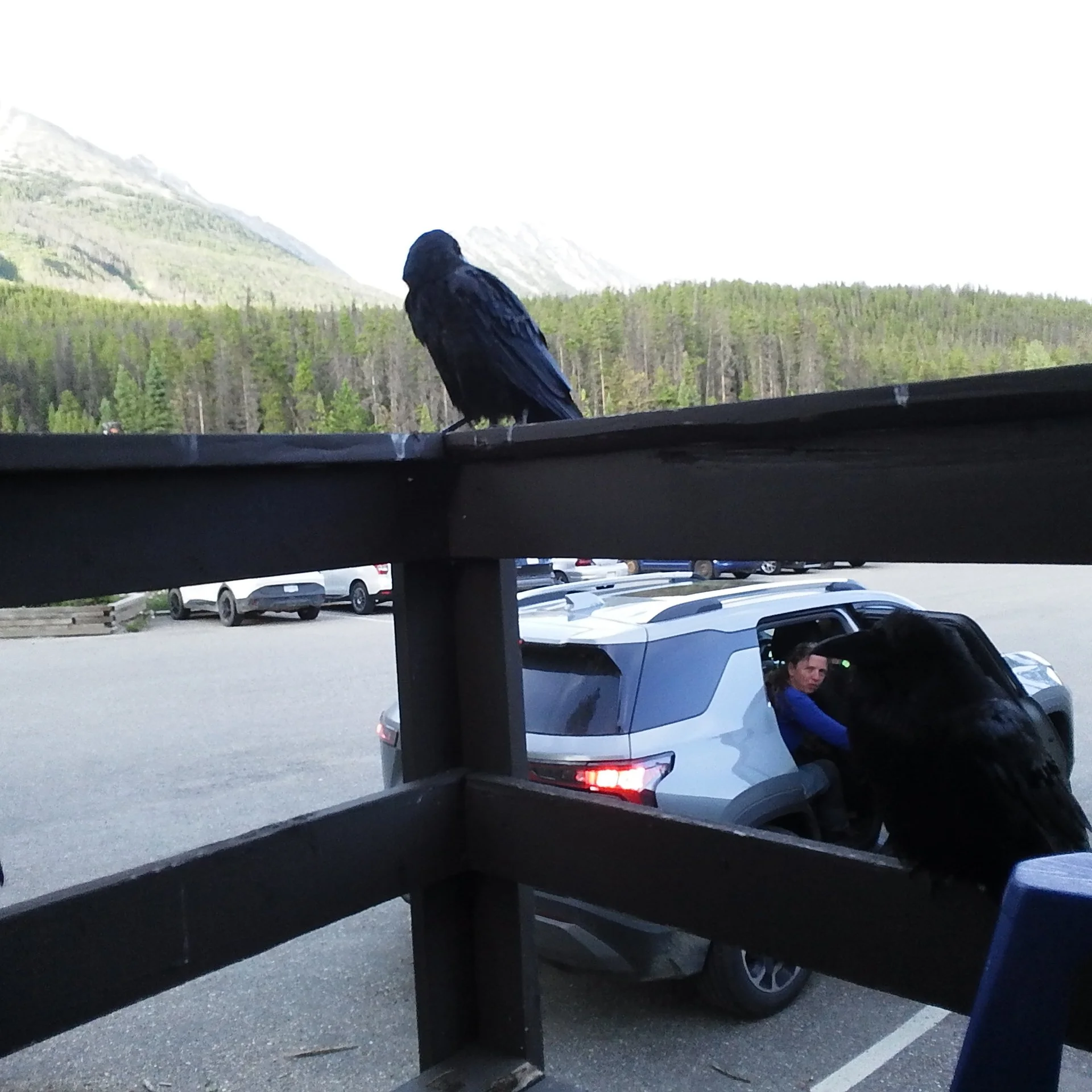
almonds as I sat outside, taking in the busy parking lot, the wonderful spherical burbles of sound the ravens offered and the dusk on the mountains in the east. The woman getting into the vehicle in this photo had just been speaking German with her family; I was lucky to take this image of her turned towards the birds on the railing. Intensely curious, her face and body posture intimate a personality and private history I’ll never know. Presumably her mind was using the word Rabe for these beautiful creatures though what incited her curiosity is something I’ll never learn. The picture itself isn’t a particularly good one in terms of composition—cropping it would improve it slightly—but it does move into the territory Henri Cartier-Bresson describes as the “decisive moment”:
The decisive moment and psychology, no less than the camera position, are the principal factors in the making of a good portrait. . . Composition must be one of our constant preoccupations, but at the moment of shooting it can stem only from our intuition, for we are out to capture the fugitive moment, and all the interrelationships involved are on the move.
On the move, yes, that parking lot, the coming and going of the ravens, the woman’s brief stare at this scene she hadn’t expected and the image pulls all these interrelationships into the centre of the woman’s face. For a few seconds her attention shifted from taking a break on a road trip to the majesty of these birds and she was wondering about them; in the precise instant the photograph was taken it is as though this human being had unintentionally initiated a kind of care that resulted from her being touched by these creatures that are neither die Raben nor ravens but individual creatures whose lives are interwoven with the particular location shown in the photograph. (And in fact, one of the ravens was inquisitive about the woman, turning away from me and glancing toward the non-avian activity taking place in the parking lot below as it perched on the porch’s balcony.) Ecology derives from the Greek ecos and the environs of Sunwapta Lodge forms their home, whereas most people are there simply to take a break from driving. One might go even further and speculate that still life photographs resemble the major function of the store and restaurant served by the parking lot along this well-traveled route. Such photographs are a pause in the flow of time; as John Berger notes, photographs perform “the task of continually resuming a life being lived in the world” (emphasis in original). My speculations derived from this photograph, however, are misleading. The world in which Cartier-Bresson took photographs, isolated that decisive moment in which content and form cohere, and in doing so, participated in the modernist project of autonomous art, is gone. Gone, not because contemporary culture has moved away from modernism and even beyond whatever postmodernism was, but because the sensibility that managed to confidently create that astonishing ethos of sharp observation, patience, and the capacity to allow each different scene in the viewfinder to find its own coherence can’t easily be maintained in the Anthropocene. Certainly, brilliant photographs are still being made, ones that would elicit respect and attention from Cartier-Bresson, but the situation in which people take pictures isn’t the same. The structures of feeling have irrevocably altered through globalization and climate catastrophe. It’s quite difficult to look at Cartier-Bresson’s famous photograph of the road moving into a line of trees in Brie, France—perfectly composed and alive to the alien nature of objects that nonetheless beckon the human eye—and consider that people in this region of the country faced temperatures of 40 degrees Celsius and wildfire smoke only a few weeks ago.[6] For me, happening to be present as the woman in a busy parking lot simultaneously found herself fascinated by the scene in front of her was a gift. A multi-dimensional gift: to view curiosity in either people or animals elicits joy and instigates one’s own curiosity. Further, this woman’s stare declared something of who she was in a way that wouldn’t likely have occurred if I’d been behind her in line at the store and remarking, after hearing her speak German, that Berlin is one of my favourite cities. Berger is again helpful; although discussing some women in Jean Mohr’s photographs, he could easily be responding to the woman in the Polaroid: “One could say that she is defined by the way she wears the world” (emphasis in original). For this woman, the world was both intensely close and yet nearly alien. After she and her companions drove away, I gave the ravens some more almonds, though signs in the parking lot forbade feeding them. Observing the digital image manifest itself into a print (itself engaging a complex chemistry of silver halide and plastic) and bringing to mind Cartier-Bresson’s 1952 essay, along with remembering his astonishing images, brought a strange combination of excitement, gratitude and grief.
When I was a child, traveling through the Rockies in the 1960s, the Athabasca
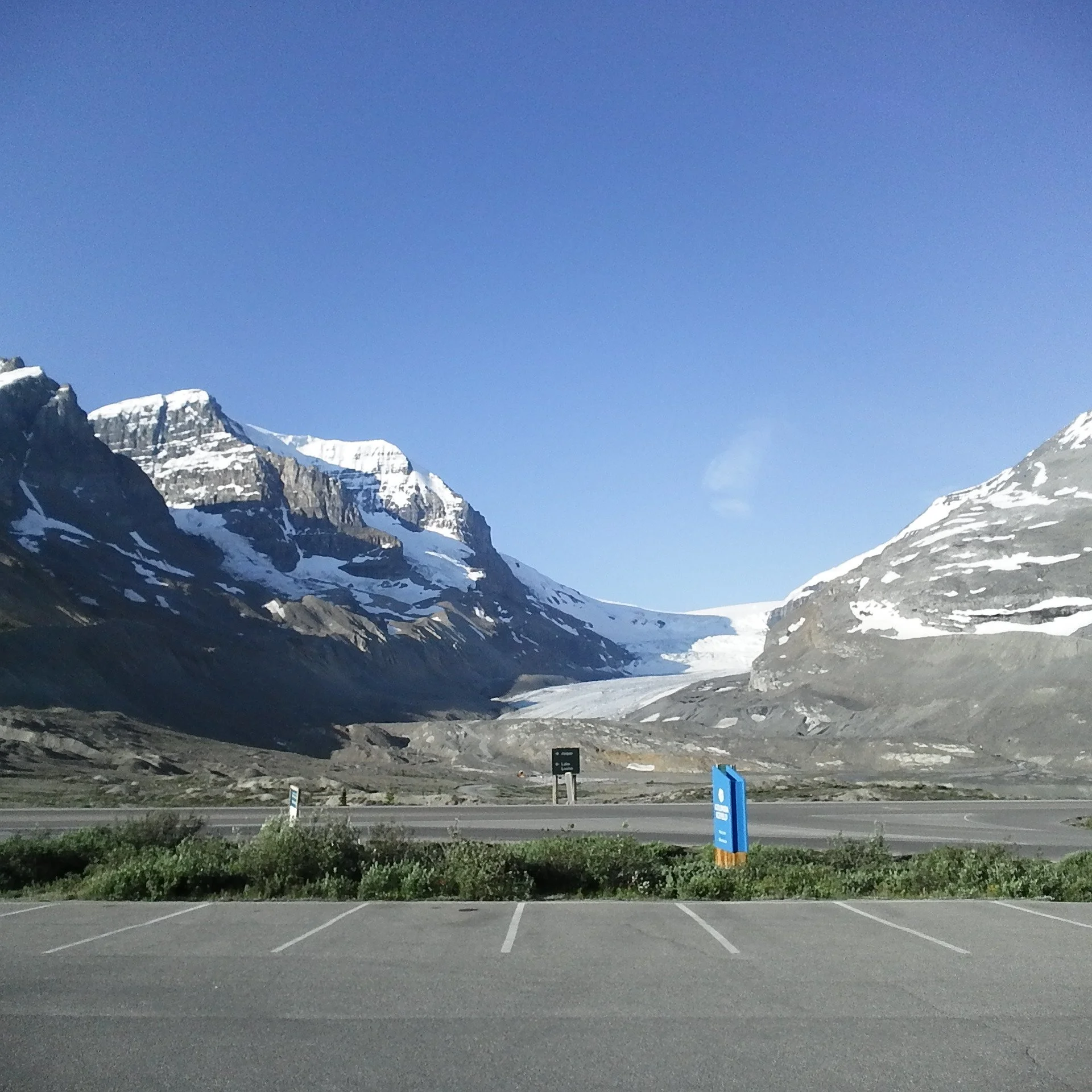
Athabasca Glacier, July 2026
Glacier nearly reached to the road in this photograph, close to the sign in the distance. None of my family members, including my father who taught geography to high school students, had any knowledge of global warming. But when my mother stopped here in her mid-seventies five decades later, she wept to see how far the glacier had shrunk into the mountains. During the early morning in which I stopped at the roadside this past July, more than a decade after my mother’s second visit, the glacier had shrunk even more, and I imagine that many thousands of people, very likely including the German tourist whom the ravens beckoned, had held their phones towards the glacier and snapped a picture. Most, I think it’s fair to say, would not have suspected that they were adding a new form of atrocity photograph to their phones. New, because most of us consider atrocity photographs to involve depictions of people—whether victims of genocidal regimes or famine—but the final image in this essay condenses unwitnessed atrocity, even though as an image it is as familiar to us as is the first one of a burnt forest in portraying the results of global warming. Consider Jay Prosser’s introduction to Picturing Atrocity: Photography in Crisis:
Atrocity is going on all around us. The least we can do is acknowledge it. . . The etymology of the word atrocity has sense of `cruel,’ `fierce’ (atros Latin). Atrocity therefore suggests an extreme violation. It implies an agent, and we thus look for a victim, so as to identify, name and condemn an inhumane act—in order to make sense of the human. Photography of atrocity challenges the integrity of the human. Yet atrocity can also exist in what appears to be the natural or accidental, or even where there is no obvious victim and no apparent perpetrator.
There are no corpses in the photograph, no starving children. Drones haven’t wreaked violence along the Icefields Parkway, a road travelled almost solely for its rare natural beauty. Yet this image summons catastrophic suffering and sorrow, even as “there is no obvious victim and perpetrator.”[7] And this is what the photograph asks us to comprehend: not only are the perpetrators of this destruction also its potential victims, but the atrocity embodied in the melted glacier, quite different from an image that depicts a specific historical event, will continue long after the photograph was taken. (It disturbs me that only about five minutes passed between the time I took to pull off the highway and press the button on my camera when I consider not only the glacier’s immense age but the centuries that will pass that still contain the emissions created by the world in which my family so blithely travelled in 1969.) If Prosser maintains that we are required to react morally to the atrocity photograph, he also offers that to do so is “in order to make sense of the human.” I don’t believe that this pictorial cliché of the Anthropocene can help us make sense of the human because we can’t easily perceive ourselves as being both victim and perpetrator. It takes considerable imagination to recognize that by simply having driven to this location one is “guilty” of causing harm.[8] Do an online search concerning flora and fauna endangered by climate change in Jasper Park and you’ll learn of the extirpation of Mountain Caribou, and the declining numbers of white pine and pica. If many people perhaps feel like bystanders of global warming, most of us are implicated as perpetrators, which is jarring because we typically associate perpetrators with death squads, and as Mann argues, the greatest amount of climate damage is done by the very few a very far distance from the shriveling glacier. A further difficulty in designating blame and responsibility arises from the ubiquity of fossil fuels both in the past and the present. Peter Sloterdijk argues:
the atmosphere retains things in its memory-banks, as it were: the atmosphere never forgot the chimney smoke of the early industrial revolution, and it will not ignore anything released into it by the coal-fired power stations of developed countries, the district heating powers of mega-cities, the airplanes, the ships, the automobiles of the affluent, and the countless open fires of the poor on every continent.
No one in polluted Dickensian London would consider themselves guilty of inflicting violence on their ancestors in the scorched England of this summer. If we consider the photograph to embody an atrocity, how can it be that an impoverished person cooking over a fire is both victim and perpetrator? Flying to a vacation destination can’t be compared to a fighter jet firing on a target; yet from the non-human “perspective” of a diminishing glacier, intention is meaningless. Is it even possible for us to grasp the enigmatic semiotics of this image? In many respects, the photograph I took is similar to the way Ulrich Baer describes contemporary photographs of Holocaust sites in which “absence becomes the referent.” That an image of the everyday is also somehow equivalent to nearly invisible devastation is impossible for the mind to sustain.
To Sloterdijk, what is necessary in confronting the Anthropocene is for our civilization to reverse its entire mode of being—economic, political and cultural—a nearly unimaginable shift in worldview: “the change in thinking required of twenty-first-century human beings runs deeper than the sixteenth-century Reformations, in which the rules that governed the transactions between Earth and heaven were revised.”[9] Evidence suggests that most of us today are incapable of changing our thinking so drastically; I fear that the next generation will be forced to undergo a conceptual shift as yet unimaginable.[10] How are we to comprehend the wreckage that awaits? In noting the reluctance numerous scientists have in speaking about the actual dimensions of the damage climate change will inflict because they fear the public will give up hope, Sandford is candid:
When did facing up to the facts of life cease to be a necessary part of life? Who is responsible for the public relations jiu-jitsu that suddenly made it acceptable to dismiss the reality you live in as being too much to bear, simply because you don’t want to face that reality. People face life-changing, if not life-shattering, experiences every day. When you are told your son just died, try to blow that off as mere gloom and doom. If you have cancer, you have cancer. Deal with it.
Sandford lost his adult son. I have cancer. I can’t speak for politicians, activists or scientists who emphasize caution in acknowledging the horror of accelerating climate change and ecological devastation, but I do know that it takes daily effort to rethink my life post-diagnosis. It is hard most days, something I ignore on a few, and brutal often. One can’t ignore the fact of cancer as one recuperates from surgery to remove a tumour, but it is very difficult to ascertain the dimensions to the way that serious illness destroys one’s habitual response to the future.
Havi Carel, in The Phenomenology of Illness, observes that illness removes the sense of the body as something operating silently in the background when it’s functioning well, to the foreground. One’s life becomes fundamentally altered; the “inductive sense of continuity is irrevocably lost in illness.”[11] Again, even though I don’t think that an individual’s experience can be extrapolated to interpret a society, there is a parallel between Carel’s observation and our present historical circumstances: continuity, as practiced by mainstream culture and public policy—its belief that the future can be predicted, its fantasy that continual growth is viable—can no longer be sustained. Continuity is over. Along with this insight, Carel poses a question that terrifies and dismays me: “Pathological cases of embodiment provide a specific tool with which to illuminate normal embodiment. But is this tool available to everyone, or only to those who experience pathology?” Perhaps owing to my mood disorders, I’ve been attentive to death and transience since I was a child, but never sufficiently. I never arrived at either Heideggerian authenticity or Buddhist acceptance. Now I have no choice but to reconcile my sense of my diminishing life prospects with this disease, and, like Carel, I wonder whether it’s possible for the ordinary person to allow this knowledge deeply inside. I’ll never know whether one can manage this depth of understanding before being forced to do so because I didn’t; cancer arrived before I recognized what Carel calls attentive embodiment. We are confronted by the Anthropocene daily; what will it take for us as individuals to recognize what this means? I don’t know, though I’m learning that serious illness rivets you to an unusual form of solitude, but it also, perhaps not paradoxically, makes me feel more deeply interwoven with others, human and non-human. Nearly daily, I try to imagine what it will mean for young people now and subsequent generations to be forced to accept ecological catastrophe as their lot. But I can’t because I live in an affluent society: the hospital that treats me is nearby and while I don’t have a partner who can help me, I do have adequate resources to be comfortable. I have supportive friends. What happens when people can’t rely on such things?
Not only are the changes required so fundamental as to confound anyone who thinks about them, our ongoing exposure to the results of climate change brings a grief that’s hard to grasp. I suspect that many concur with Tim Lilburn (who has recently developed melanoma) when he notes: “the nature of the sadness that is and will be experienced in the face of the effects of global warming . . . [is] unlike anything in memory or imagination.” My personal sadness about health is something many take on. About to begin immunotherapy in a couple of weeks, I’m grateful that this treatment is available at no cost to myself. I’m aware that a cancer diagnosis is, and has been, one shared by an unimaginable number of people and this makes Lilburn’s simple point lacerating. A new form of sadness is here, and it will worsen, splinter into intricacies unimaginable only a lifetime ago. This sadness isn’t necessarily more intense than that inflicted by previous calamities, nor by the threat of terminal illness, but it is different. This is a sadness that has become metaphysical. “Our problem is that violence is being done to reality,” argues Jan Zwicky, “meaning is being abused.”
[1]Referring to the new geologic period after the Holocene as the Anthropocene is common to various scientists, scholars and artists. It is important to note that other names have been proposed that are more specific to the causes of this new period such as the Petrocene or Capitalocene. See Christophe Bonneuil and Jean-Baptiste Fressoz’s The Shock of the Anthropocene for an historical treatment of the various other labels assigned to the Anthropocene, a term I prefer for its wide usage and general acceptance.
[2]Only after reading Matthew Scace’s account of the fire, did I learn that the Canadian government forcibly evicted Indigenous people from the area so that the park could be established decades ago. Never once did I wonder about the first peoples who lived there.
[3]While it is crucial to develop renewable technologies, Jonathan Franzen correctly maintains that “renewable projects are only a moderating tactic, unable to reverse the damage the past carbon emissions will continue to do for centuries.”
[4]Various writers take this position. Emmanuel Levinas is blunt: “There is something wicked and egoist and cowardly in artistic enjoyment. There are times one can be ashamed of it, as of feasting during a plague.”
[5]Berger observes that “a photograph quotes from appearances, but, in quoting, simplifies them.”
[6]The 2026 September issue of Harper’s Magazine notes the following: “Estimated number of excess deaths in India caused by a single day of extreme heat: 3,400. Caused by five consecutive days of extreme heat: 30,000. Minimum number of heat-related deaths in Europe since 2022: 200,000.”
[7]That Prosser refers to “satellite shots of the ongoing devastation following the Deepwater Horizon oil spill” would suggest that he would concur with me describing my snapshot image as an atrocity photograph.
[8]One can cause harm not merely by driving. Thomas H. Ford notes that “any instance of text, whatever it might say, is also in social and material terms so many kilograms of embodied CO2.” Writing this essay causes harm.
[9]Although Sloterdijk uses the term Anthropocene in his essay, he admits that, owing to culpability, “Eurocene” would be a more “apt” designation.
[10]I was once at a forum dedicated to discussing climate change; on the stage were some local politicians, activists and climatologists. During the Q/A I raised my hand and was given permission to speak. Pretending to bumble in my jacket, I asked the large audience to be patient: I told everyone that I was reaching for a cigarette to smoke because talking in public made me nervous. I swear every single person turned toward me in a blend of horror, anger and disgust. I’m kidding, just kidding I said, but when I was an undergraduate it was acceptable to smoke in class, I said. Things have changed. What we need to do, I suggested to the room, is approach our entire social fabric with the zeal required to eliminate smoking in public. Every decision, every architectural plan, each conference held on campus needed to factor in its consequences for the environment. No one had much to say about my remarks and the panel went on to the next question from the floor.
[11]If one is so fortunate to be successfully treated for cancer, one then moves into a new psychological entity, what Siddhartha Mukherjee calls a “previvor,” someone who is “a person who lives in constant anticipation of an illness that she is predisposed toward, but has yet to have. A survivor has lived past an illness she had already had. A previvor, in contrast, lives in anxious wait for an illness that she may or may not have in the future.”