
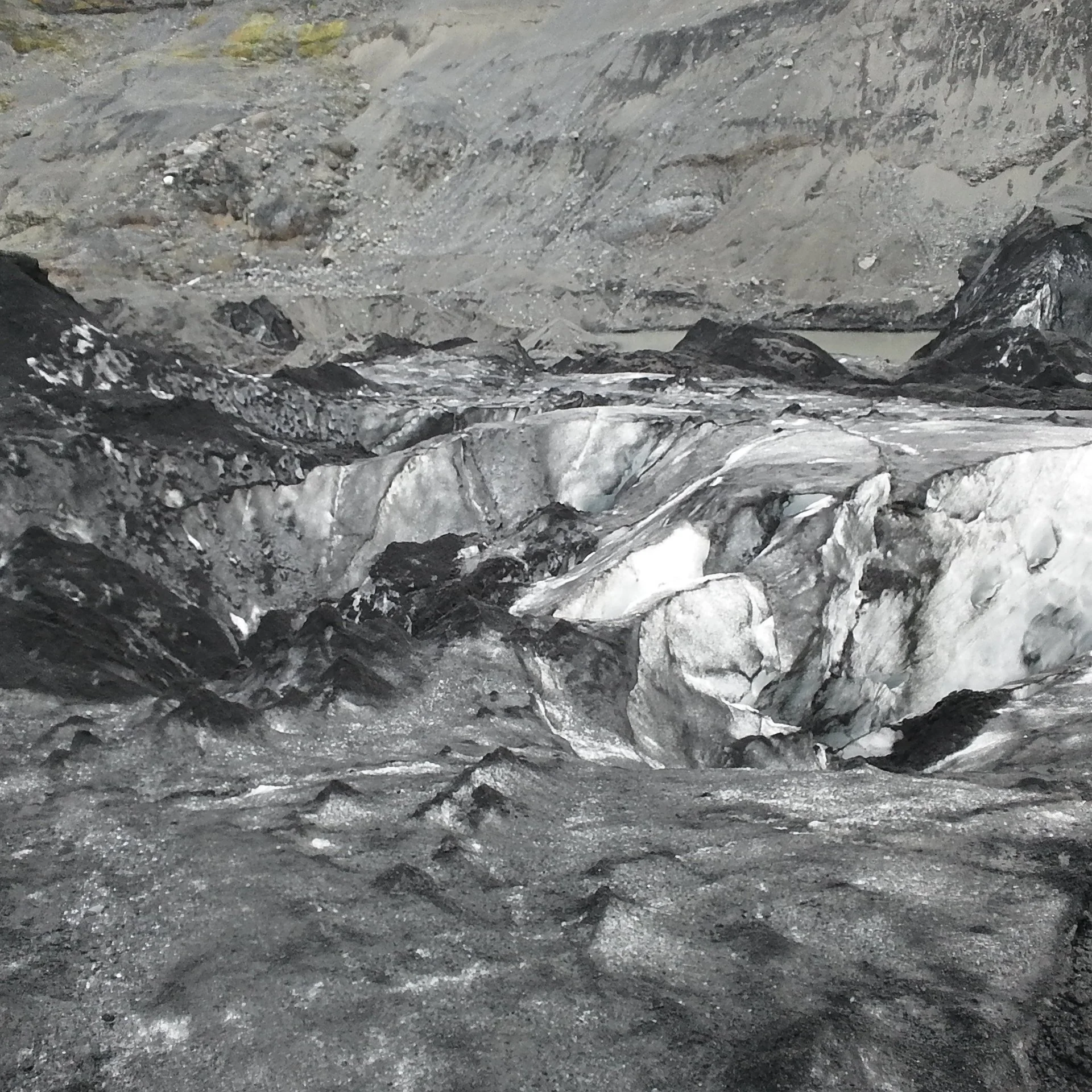
Diminished glacier with volcanic ash. Iceland, May 2026.
When my youngest and oldest sons joined me in watching Kane Parson’s Backrooms, the three of us agreed that the movie operates in numerous registers simultaneously, but we also discerned allegorical interpretations that seemed to reflect not only our personalities but also our ages: 16, 27, 66. My youngest son saw it as an embodiment of internet culture and a critique of AI; my oldest son is doing a graduate degree in philosophy and, having recently finished a course on Danel C. Dennett, felt that the film’s intricate treatment of memory and emotion suggested that it was an examination of consciousness. With my recent cancer diagnosis, and ongoing concern with the Anthropocene, I thought it managed to create what Raymond Williams would call the “structures of feeling” inherent to becoming a cancer patient and what it means to be alive at the onset of the Anthropocene. Friedrich Nietzsche would solemnly and jubilantly nod at the three of us, having observed: “The human intellect cannot avoid seeing itself in its own perspectives, and only in these. We cannot look around our own corner” (The Gay Science, section 374, italics in original). Watching the movie, I was reminded of Kafka and specifically Martin Greenberg’s suggestion that Kafka’s work often embodies a sort of dream narrative. In Kafka: The Terror of the Art, Greenberg writes:
You have to stand inside the story and outside the story. This is of course what happens with dreams. Dreaming, one feels the dream as literally true; awake, one analyzes it as a metaphor. Kafka’s art unites feeling and analysis; it asks that you should respond to its reality directly and wholeheartedly without standing off at a distance, and also that you should interpret it by analysis. It is an art that unites poetic vividness with intellectual subtlety.
Attempting to inhabit the dream of Backrooms through the eyes and one’s own unconscious, one is also invited to step outside of the labyrinth and analyze it. My suspicions are that my youngest son’s take on the movie is more closely aligned with Parson’s. After all, the scene that repeatedly reproduces the floor of Mary’s childhood home, making it simpler and simpler, eventually nearly eradicating it, is similar to when you ask AI to keep doing things; there’s repetition and then disappearance. But for the sake of this blog, I want to think along with the movie to gain an understanding of how a specific text illuminates contemporary serious illness and the chaos that widespread wildfires, drought and increased temperatures inflict on the present.
Before proceeding, let me locate Backrooms in a larger cultural history that precedes the internet. The movie operates on archetypal memories and perceptions and makes numerous allusions to twentieth-century art movements. Early in the film, for instance, Clark wears a t-shirt that says Modernist, and his response to Mary’s question “where are we?” is the gnomic, yet precise “It’s every place that ever was.” Regarding Modernism, various images and mise en scène recall Surrealism generally (especially the paintings of Salvador Dali and Rene Magritte), but the movie also evokes the artwork of Michel Basquiat, Christian Boltanski, Robert Rauschenberg, and so-called Outsider Art. (Not to omit Hitchcock.) These allusions noted, I think that what’s most crucial to the movie’s capacity to unnerve the viewer is its archetypal images and cinematography. In accentuating the concrete palm print Mary made with her mother (and then in true neoliberal fashion, the family home, which cannot protect itself enough from the outside, is destroyed to create condos) the film evokes our likely innate and very ancient desire to forge a monument to ourselves, but it also recalls those hand prints painted in prehistoric caves, often showing an adult’s hand alongside a child’s. In fact, the backrooms themselves recall underground cave paintings. The border between Clark’s rubbishy furniture store and the other-world of the “backrooms” is liminal. Here is David Lewis-Williams in The Mind in the Cave: Consciousness and the Origins of Art:
If we allow that Upper Paleolithic people believed that the spirit world lay behind the thin, membranous walls of the underground chambers and passages, the evidence for finger-fluting, handprints and much otherwise incomprehensible behaviour can be understood in rational, if not absolutely precise, terms. In a variety of ways, people touched, respected, painted and ritually treated the walls of the caves because of what they were and what existed behind their surfaces.
In this sense, the film would seem to enact a sort of psychobiography that is both individual and transcultural. (My eldest son is on to something as well.) The movie has its specific origins in creepypasta, and as such, it reverberates in our collective unconsciousness. However, I think it’s fair to say that our contemporary collective unconsciousness is underscored with atavistic images and fears alongside a sense that something is very different, and very wrong about the present in comparison to the past. Call it the Anthropocene. Of course, not everyone is aware that we have passed into the new period. But not knowing its geologic designation doesn’t mean that its presence isn’t felt by people as both a visible / invisible atmosphere and in the unprecedented disasters inflicted by global warming, ocean acidification and toxic waste. By atmosphere, I mean something like Tonino Griffero’s definition of atmosphere as a theoretical construct in his essay “Are Atmospheres Shared Feelings?”:
It is, more specifically, a feeling poured out into a certain (pre-dimensional) space, inextricably, linked to felt-bodily processes and characterized by a qualitative micrograndular presentness, that is, by definition, inaccessible to a naturalistic-epistemic perspective. In this sense, an atmosphere is also an example of the passive synthesis largely intersubjective and holistic that precedes analysis and influences from the outset the emotional situation of the perceiver, resisting mostly any conscious adaptation or epistemic correction.
Enter Backrooms, or lie on a hospital cot waiting to be taken for x-rays, or get up in the morning and check the air quality for wildfire particulate—one can consciously be aware of viewing a movie, of wearing a paper wristband identifying you as a patient or turning on an air purifier but each of these experiences cascades into a felt atmosphere in which not easily understood forces confront the individual, making deliberate adaptation very difficult and often incoherent. There’s always more to the problem than what you can do in response to it. And each problem is multiple. Furthermore, this experience, while private and rooted in one’s individual body, is also porous to the communal. A hospital is a mesh that includes its overworked staff, omnipresent yet mysterious technology, and (apart from the maternity ward) general misery and fear that exudes from patients and visitors. The private is shot through with the public. Hazardous air quality is similar; it seeps into our individual pulmonary and cardiovascular systems and yet is widespread. Its sick orange glow has a resonance with the nearly poisonous yellow of the backrooms, flickering around everyone who enters them. What most signalled the Anthropocene to me, apart from the atmosphere of the film, is Clark’s unceasing and vehement denial that he bears some responsibility for his condition (aligned with our overall incapacity to recognize and act upon our complicity in global warming) and the scientists’ baffled response to this entirely new phenomenon that has emerged in their world.
In both Backrooms and our historical reality, there’s the sense that our “normality” has ended. In Mathew Lawrence and Laurie Laybourn-Langton’s disturbing Planet on Fire: A Manifesto for the Age of Environmental Breakdown, the authors are unequivocal:
All states, markets, economies, welfare systems, militaries, major religions, scientific breakthroughs, cultures, medical advances, wars, and the people that fought them came about during a uniquely stable period of Earth’s natural history. That era is now over. In its place comes a new era of accelerating environmental destabilisation. The accumulated burden of centuries of exploitation and destruction now threatens the safe functioning of the natural systems upon which all life ultimately depends. Ours is the age of environmental breakdown.
The key mortifying sentence—that era is now over—certainly speaks to the destabilized climate, but it also pertains to the permanent loss of “normality” a cancer diagnosis bequeaths to the person whose identity must suddenly assume that of being a very specific kind of patient. Before I turn to the way that Backrooms nearly pulsates with the negative energy of being a cancer patient, let’s go through parts of the movie as a tentative exploration of what it means to be alive in those industrialized societies whose economic and psychological order is that of neoliberalism at the onset of the Anthropocene. If the older characters in Backrooms seem capable of leaving the repetitive and dangerous maze with yellow walls, the younger characters can’t. They are caught and destroyed within the malevolent yellow maze, which, if one compares their situation to the way the various generations will face the Anthropocene, makes sense. While no character ultimately leaves the backrooms, Kat and Bobby are never capable of returning to the “normal” socio-economic order and life-world of what Lauren Berlant calls the just-before-times. But this temporary “stability” is being eradicated for everyone, not only the young; as supposed expert Phil notes, “there are doors opening everywhere and we don’t know what’s happening.” While climate scientists are in uniform agreement that global warming is anthropogenic, Phil’s baffled and anxious confusion is a feeling-state that is common to researchers and laypeople, though variously. No one knows how societies are going to react to the deep Anthropocene; once its many effects appear simultaneously around the globe, societal collapse seems likely. Again, I’m not arguing that Backrooms is an allegory for the Anthropocene; rather, more than any recent film that deliberately evokes global warming—think Don’t Look Up or Interstellar—Parson’s movie traffics in the prevalent mood and atmosphere of ecological dread, a horrific outer-inner state that permits no escape. It doesn’t matter whether Clark is a pirate or a sultan; it doesn’t matter if objects from the backrooms intrude on normality—the inverted stop signs like defamiliarized calving icebergs—because all boundaries are breaking down. And we are all caught in loops, to borrow from Mary the therapist, but from the Anthropocene there is no hope of a cure, or escape.
A word about Mary: if Clark’s central emotions are rage and frustration, Mary seems locked inside traumatic sadness, whether as a child who is helpless around her psychotic mother or as the Still Life version of herself in the final scenes of the movie. Again, this is a feeling-state common to many at the onset of the Anthropocene. In Numinous Seditions: Interiority and Climate Change, Tim Lilburn notes: “The nature of this sadness that is and will be experienced in the face of the effects of global warming . . . [are] unlike anything in memory or imagination. It occupies an entirely new category . . . it is an entirely new sorrow” It is precisely this strange emotional blend of sadness, unfocused grief, and fear that permeates the film and our present.
Cancer.
Early in the film, viewers take on the POV of the terrified Naren, muttering OK, OK, OK to somehow calm his heavy breathing. He’s entirely isolated, pleading for help from others who observe him from the safe distance of a computer screen. Watching Naren stumble through a labyrinth of rooms instantly recalled my experiences of beginning what well-meaning but inept people call one’s “cancer journey.” The intense loneliness; being perceived not only through one’s new identity as a cancer patient but on the screen to one’s side on which the doctor points out the tumour; then a seagull sharply smashes into view and then disappears, just as, throughout cancer treatment, something always interrupts and takes you by surprise. “I need you to help me,” Naren begs, and yep, this is how it feels to be inside the cancer production, hopeful that the nurse or doctor can indeed do that, help, alleviate, but you can’t help but think, no one can actually give you the aid you ultimately need: whatever it is that will produce a cure. Meanwhile, all around the cancer patient is nearly an hallucinogenic babble of voices (as in the movie)—not only of medical terminology the layperson can’t decipher, but also the millions of people who have been diagnosed with cancer, some of whom have survived and many more who are like the extinct languages in the voice-over: Hittite and Akkadian.
After crawling through a tunnel on his initial foray into the backrooms, Clark enters a room with shoes and furniture half stuck in a floor which evokes sinners in Dante’s Inferno, or those transfigured in the Hell portion of Hieronymus Bosch’s The Garden of Earthly Delights. Or, in a hospital, where patients and their various body parts are sliced, removed, examined and put on view. Then Clark asks: “is anyone there?” and the answer to the cancer patient is yes, but also no because no one really can pierce the isolating fog / mist / fear and near despair of the patient alone with their body and the bad TV of their minds. Later, in the consulting room with Mary, Clark babbles: “I found a place in the store. There’s a wall and on the other side of the wall, the store just keeps going like a copy of itself but then none of it makes sense.” Bingo. Cancer just keeps replicating itself but none of it makes sense. The longer I stay watching Backrooms (as of writing this blog, 3X), the more I felt what one of the key phenomenological components of experiencing serious illness is: waiting. In her memoir Illness: The Cry of the Flesh, Havi Carel writes:
The patience required to be a patient demands of those who have less time (both because they may not live long and because being ill is time consuming) to spend it in waiting: waiting for test results, waiting to see the doctor, waiting for the next appointment, waiting for the particular pain killer to kick in. Time spent in pain or discomfort is experienced as slow and enduring.
CUT to young Mary in her disgusting house, with its garbage, flies, newsprint on windows. Her agoraphobic mother says, “Mary what were you thinking, I never, ever said you could go outside, it’s no good.” Mary’s childhood home seems to be a poverty-stricken, demented inversion of the yellow place; Mary whose real identity consists not of her being a counsellor really but a chronic patient. At the movie’s finale, the Async Research Institute will now study Mary and each of us who has found themselves in the poisonous labyrinth that self-replicates itself with the DNA of its denizens. And all around us, the clutter of real and imagined furniture, defamiliarized, unnatural, twisted objects = growth of a metastasizing cell.
Scurrying through the nightmare architecture, Mary gets back to the furniture store and stumbles into canisters of gas going off like wildfire, only to be dragged by three guys in Hazmat suits to be confronted by people in white coats. Scientists, doctors, it doesn’t matter, the white coat signifies power against which the rest of us are helpless. CUT to flickering X-ray image of Mary’s skeleton, then like full body, and skull MRI scan, then Mary’s cleaned up and given fresh clothes, then Mary being lead through hospital corridors. Then, then, then. She has zero agency and has become an alien to herself and the world she thought she knew. Here is the brilliant Mary Cappello, from her cancer memoir Called Back: My Reply to Cancer, My Return to Life:
It wasn’t enough to be cast a far distance from the self by cancer and its cure. I became stalked by a sense of my absence on the culture’s rectifying grid . . . All the love and support in the world cannot and perhaps should not cancel out the fundamental aloneness one experiences at various points in the course of a treatment for cancer. (emphasis mine)
“Please Phil, where am I?” Mary asks her white-coated interviewer (who keeps glancing back into what must be a mirror that hides others).
All Phil chooses to say is that he’s stymied and he appears to be frenetically concerned: “I’m convinced that nothing in our lifetime, nothing in maybe all of recorded history means more than this but I can’t understand. I can’t describe it.”
To which Mary appeals: “What’s going to happen to me, Phil?”
Phil looks around nervously, “that decision’s not up to me.”
Indeed. Enter the Anthropocene, the cancer ward—neither place / condition I would wish upon anyone.