
When the Earth Breathes, Johannes, it Releases Ravens
Fragments are the only form I trust. . . . See the moon? It hates us.
Donald Barthelme, “See the Moon?”
It wasn’t until my early 50s that I was diagnosed with a learning disability. Until I learned of it much of my life was awry: simply inexplicable. And yet, despite my now having an awareness of the problem, anxiety continues to blossom like pond algae.
Prozac helped with my mood disorders for a while. Ditto Paxil. Pristiq, Ah, no. Trintellix; and Siv-Mirtazapine, we’ll see.
My drug of choice used to be beer, followed by red wine, then tequila. Always nicotine. For fun in my teens and early twenties: LSD, weed, magic mushrooms, scoops of bennies.
When I recently discovered that a psychologist (who engages in pioneering research in NVLD) believes that, of those who have learning disabilities, it is those with NVLD who are most prone to suicide, I wonder about psychic autonomy. Seen one way, there’s almost nothing that’s more expressive of the individual subjective will than when someone freely rejects what their life has entailed and chooses to end it. And yet, how can anyone who’s ever been diagnosed with a chronic mental disability not be undermined by the fact that what previously felt like autonomy has likely been profoundly compromised by something of which they weren’t aware before diagnosis?
I have boxes of diaries going back to adolescence, most written with a fountain pen, and in one of them I taped the blade from a case cutter left over from grocery store shifts after I used it to slice up my left arm, legs and shoulders because I didn’t have the guts to go further.
A feeling of failure so corrosive it requires a soundtrack containing a trio of dead men, each playing an accordion.
Are Lauren Berlant and Kathleen Stewart right to claim that personality is scar tissue?
*
When I look into an interior mirror, these are some of the reflections I see:
—My first memory seems to be the assassination of JFK: all I can remember is a TV screen in my grandparents’ living room, some KFC, and the feeling that something was off-kilter. The adults in my life were upset in an unusual way. Upon her death from diabetes three years later, my beloved grandmother gave me the permanent gift of knowing that reality is partially woven from the sense that something is utterly wrong.
—A neighbour alerted my mother when she found three of my GI-Joes crucified on crosses which I made from sawed hockey sticks, which I left in the woods behind our house when I was a boy. Red magic marker made their hands and feet look bloody.
—Walking alongside an enormous indoor cage that held a tiger, it following me. The zoo in Detroit was dilapidated, and I’d never been watched by an animal that intently. “He wants to eat you,” my mother said, but I can’t see her in the memory. It’s damp, cooler than outside. I know the tiger can’t get out of the cage. I can also sense that there’s something ancient inside the tiger; it is much older than its actual age. It’s older than any animal I’ll ever encounter, this creature following me on grimy sunlight on the wet, cement floor.
—Trees in a campground outside Munich. The German campers are all wearing Adidas track suits, which is very strange to our Canadian eyes. Back home, only athletes wear track suits. I can smell pine. It’s July 19, 1972. I’m looking at pictures in a guidebook my Dad bought at Dachau concentration camp only a few hours before.
*
In a recent study on Holocaust diaries, Amos Goldberg observes that “for significant numbers of non-Jews the Holocaust acts as a central identity-founding event.” He doesn’t probe this odd situation, though I wish he had. When my parents took our family to Dachau when I was twelve, neither they nor I grasped that the visit would permeate my unconscious, eventually resulting in a life-long obsession with the death camps.[1] Whatever it was that affected me that July afternoon went underground for decades. While I can’t say for certain when thoughts of the Holocaust began to return persistently, I remember holding my daughter Annie (now Andy) only hours after her birth from a C-section in 1996. Lynn was asleep—her difficult labour had gone from 10:00 p.m. on a Tuesday night until sometime after 6:00 p.m. the next day—and I, too, was exhausted. As I held our first child, I felt two things: nothing anywhere was as important as they were; and then immediately something else—other parents must feel the same way, but those who had to protect children during the Yugoslavian war that was currently taking place, or earlier, those who had waited their turns for the gas chambers at Auschwitz-Birkenau, these parents hadn’t the luxury of holding a sleeping child safely in a downtown Toronto hospital.
*
When the three of us moved from our apartment above the health food store in Toronto to Regina we rented in a townhouse complex. There was a bit of sidewalk and grass between the rows of homes like a U. Among our neighbours was single mother who worked at a car rental service. She had two boys, the youngest used to squash grasshoppers between thumb and forefinger and say “I’ll crush your nipples.” His brother would knock on our door, asking for food. They would be men now. When Lynn and I unpacked in Regina we found only one stowaway cockroach in the boxes. I haven’t seen one since.
*
Much of my professional life has involved teaching and writing about the short story. Two questions recur in class discussions, one posed by A.S. Byatt in her review of Alice Munro’s The Love of a Good Woman: 'Do we experience life as a continuum or as a series of disconnected shocks and accidents?” Both positions are accurate enough, though the depressive in me knows that I’m continuously fastened to events in the past that took me by surprise, and that events such as these can sever a life from itself. And then there are those appalling moods that one continually orbits, psychic centres of gravity that can be predicted as often as they can be triggered by an unforeseen constellation of events, accidental conversations, or the look in another’s eyes when they’re angry.
Another question the short story revolves around concerns ethical and psychological hermeneutics. In The Genesis of Secrecy, Frank Kermode sympathetically refers to Wilhelm Dilthey’s notion of the “impression-point,” that incisive moment of a life or a text which “gives articulation to the whole.” James Joyce’s Gabriel Conroy experiences a psychological impression-point when he grasps that he needs finally to permit finitude to enter his life as he watches Greta asleep in their hotel room while snow falls in Dublin.[2] Thinking of an impression point in ethical terms perplexes our civilization. It doesn’t know how to resolve whether an action (or series of related actions) defines a life. Consider Kaing Guek Eav (Comrade Duch), once a math teacher in Cambodia, who eventually commanded S – 21, a detention centre run by the Khmer Rouge in Phnom Penh during the late 1970s. According to Michael Paterniti, Duch had initially overseen “a jungle prison camp, where he’d studiously refined his ideas about torture, and was then put in charge of S – 21 . . . [where] he condoned “`living autopsies.’” Later in life, Duch converted to Christianity and worked as a health supervisor for refugees. Ultimately placed on trial for crimes against humanity in 2009, he was sentenced to serve nineteen years in prison. Observing Duch’s remorse at the trial and the way he “devoted his full attention to each witness” who testified against him, the philosopher Alphonso Lingis asks: “what would be accomplished, for him and for us, and for twelve thousand people now dead, by imprisoning him for the rest of his life?”
Comrade Duch died on September 2, 2020 of a lung disease. His body had no autopsy because it was immediately cremated owing to concerns about COVID.
*
Put yourself in another’s agitated shoes, honesty being not so much a pursuit as a performance requiring its own diagnosis.
*
[The essay] thinks in fragments, just as reality itself is fragmentary, and finds its unity in and through the breaks and not by glossing them over . . . . Discontinuity is essential to the essay . . . The essay has to cause the totality to be illuminated in the partial feature, whether the feature be chosen or merely happened upon, without asserting the presence of the totality.
Theodor W. Adorno, “The Essay as Form”
*
When I write a poem, I always implicitly address it to Don Coles, something I did when he was alive, and still do, now that he’s gone. I studied with him in my early twenties, as did Lynn, and we invited him to our wedding. He wasn’t able to attend, but gave us a collection of essays by Robert Hass and book of poems by Geoffrey Hill as a wedding present. The Hass volume is with me, the Hill, Lynn. Although we wrote to congratulate him when he won the Governor’s General Prize in 1993, we gradually lost touch and twenty years passed between the final class I took with him at York University and when I met him for lunch at his favourite restaurant in Toronto, Grano’s, in 2006. I was in Toronto to launch my first book, a collection of short stories.
As we looked at the menu, he tried to summon up the particular group of students who made up our class so long before, and I reminded him of a reading he’d done when he published Landslides. The title poem describes visiting his mother at the Gericare Centre in Woodstock, where she was suffering from Alzheimer’s. To this day, I can recall when he read of wet, yellow leaves on asphalt, leaves he’d seen on a particular visit with his mother when she still had a sense of what was happening to her. Had she died then, Don wrote, while she could still demonstrate a degree of awareness, he wouldn’t have begun the poem. But she continued to deteriorate. Her misery caused Don to understand what he calls “the intimate cynicism of the world.” As he read of the autumn leaves in the rain that late afternoon in the 1980s, my memory pulled in such colours summoned by rain, a paved driveway, the safety in childhood of returning from the library with books on a day in October. And as he continued to read, the line identifying the world’s intimate cynicism slammed into me from nowhere. If I can’t quite hear his voice today, I can still picture the image in my mind that his words created: it had such tender, brutal, beauty. At the end of the reading, during the question period, I asked whether he would read that specific section again, the one with the yellow leaves—and he did. But there at Grano’s some twenty years later, he easily remembered the reading because he recalled a young asshole who asked him to reread a section from the poem. I don’t remember his name, he said. The bastard, he went on, he could tell that I almost lost control when I read the section the first time and he wanted to see if I’d crack. But I didn’t, Don told me. I read it again, and I didn’t stumble.
*
Don and I met at Grano’s every time I visited Toronto. I revelled in his lovely habit of turning his body sideways when he laughed. Even today, I can see him telling me that the light in Bergman’s films is devoid of anything that could bring harm into the world . . . when we both get brain freeze. What’s the name of Bergman’s central male actor?
*
These fragments—written in a kind of abbreviated code—can’t avoid being incoherent even when they’re their most precise.
*
Max von Sydow: 1929-2020 Anne Frank: 1929-45
*
When I aim to get my 200 minutes a week of hard cardio on a second-hand stationary bike in the sunroom here upstairs . . . overlooking two well-stocked bird feeders, I listen to Nine Inch Nails to provide inspirational anger. Nirvana: energy. Self-pity: Joy Division. Strenuous exercise at my age teaches decay.
Why didn’t anyone tell Joy Division that it was wrong to choose the band’s name because they thought that’s what the Nazis called the sex slaves they kept in camp bordellos?
Is anything innocent?
I once drove to Butte, Montana because I wanted to see whether the town really had the amazing colours Wim Wenders gives it in his movie Don’t Come Knocking.
*
I’ve never felt at home anywhere but, if given a choice, would live in Amsterdam.
*
My favourite painters are Rembrandt, Vermeer, and Rothko. Always Anselm Kiefer. Gerhard Richter.
And also what the water gave Frida Kahlo.
*
Reading The Shock of the Anthropocene, I have at long last realised that historical knowledge is as important as philosophy for apprehending the present and its various manifestations of reality. There is an invisible Model T Ford parked beneath the bird feeders swaying in the wind and snow. But beneath the Model T is something else. Oil’s insatiable fire on the sun flower seeds and worn down snow. And what is oil? “In her study Living Oil: Petroleum Culture in the American Century, Stephanie LeMenager is blunt: “Oil was literally conceived of as a replacement for slave labour.”
Could someone please do a cost-benefit analysis of what it means to be alive now?
*
When I was a child, my parents often had parties on Saturday nights. After a dance at the community centre, they once convinced the band to come home and play in the furnished basement where Dad had built his own bar, using cedar shakes for decoration. On Sunday mornings before church, while my Mom and Dad were still asleep, my sisters and I would explore the clutter in the basement, sometimes nibbling a bit of cold pizza in the beer fridge, always helping ourselves to leftover chips and pretzels, the strange dip my mother used to make for parties out of sour cream and a dried soup mix with small noodles and spices.
Secrets spilled from the upholstery like leaking bags of sleeping and hung over grownups, their brilliant hours having vanished into perfunctory place-holders: it’s a pity that time was an undeterred hoax that eventually maimed them. My father has always believed an invisible dome would keep him—but not my mother, no—tolerably safe all the days he stays inside his dreams of being an exception.
And the gathering
Graces would come by Sunday mornings to
collect ashtrays and a few glasses of old scotch, an elixir that smells
of golden burlap and some kind of music that’s kept underground
and to
repudiate the colour slide show of car crashes, heart attacks
and what keeps getting abandoned
like old swimwear in the mind—
*
The intimate cynicism of the world.
*
A hummingbird makes a Rothko of air—
*
Working as a steward in a private businessman’s club when I was twenty-two—no women, not even a female letter carrier, were ever allowed through the door—taught me lickity-split that Karl Marx had fully understood the nature of his foe.
*
Once I was in a banquet hall for a conference in Lisbon and listened to Amari Baraka give an impromptu speech chastising a well-known literary theorist sitting two tables away, a man who emphasized epistemology in his books over history, politics, and race. The latter left midway through the jeremiad; afterwards there was a small amount of applause, but mostly silence.
How attentive should a person be to the events, ideas and debates of their time?
—the reader might listen to “Fitter, Happier” by Radiohead from OK Computer
—the reader might further identify something significant that took place last year, and then try clarifying what shape it will take next Monday, and then scrutinise what happens to it when History does what it does, taking apart and reassembling everything that ↔ has come before.
*
Skyrim. The video game that currently obsesses Jakob, who could be mistaken for a Viking (though ½ of his heritage is Ashkenazi).
*
Though my model for this form comes from Susan Sontag, Fanny Howe and David Markson, it seems that writing in fragments has very much become a contemporary style: Maggie Nelson, Jenny Offill, and Patricia Lockwood—are practitioners who come to mind. I’m unsure what lies behind their choices to write in this mode, but mine is derived from an abiding interest in what constitutes a detail. Ezra Pound’s “A Station in the Metro.” A still photograph.
A resonant detail is something in the world beyond the self, something that looks into you.
*
Expected or unexpected, the moment that exposes and disarms the sinister passage of time.
Michel Leiris, The Ribbon at Olympia’s Throat
Time can’t be disarmed, but there are moments that embody its passage. Walking by a sex shop on Granville Street in Vancouver after having a sushi dinner with a friend I’ve known for almost three decades, I notice a piece of paper taped to the glass door from the inside: “Closed because of family emergency. SORRY!”
*
And: a fragment as conceptual art: “Wondering when and where the last casual streetcorner conversation in Latin might have taken place,” ponders David Markson.
*
Ignoring the news while Amy, Jakob and I have been in Golden, British Columbia, mostly to go hiking (when there’s no smoke from forest fires), I’ve only just learned that Charlie Watts, the drummer for the Rolling Stones, died three days ago. I saw the Stones twice when I was a teenager, once at Buffalo’s Rich Stadium on their Some Girls tour in 1978 (72,000 fans); the second time at their benefit concert for the Canadian National Institute for the Blind (CNIB) part of the sentence ordered by a judge for Keith Richards being busted for possession just days before the band partied with our current prime minister’s mother, Margaret Trudeau. I also learned this morning that the Liberals are trailing the Tories in the polls. Justin
“I wouldn’t want my wife associatin’ with us,” drummer Charlie Watts grinned [in 1977], as Margaret posed with [The Stones] in Toronto.
Trudeau was seven when his mom hung out with the Stones; it was his parents’ wedding anniversary. Today his younger brother and father are dead, and his mother is seventy-two. If connecting details can be a spurious pastime—Maggie Trudeau met the Stones on March 21, 1977, one week before Amy was born—these sorts of details very frequently embody what Leiris calls the “sinister passage of time.”
*
Fragments can be accumulated endlessly, though their arrival always takes me by surprise. This morning Jakob told me that he’d learned on the Internet that tigers will likely be extinct in thirty years. Only yesterday, I read the following sentences by Graham Harman, the founder of object-oriented ontology:
Somewhere in his correspondence, H.P. Lovecraft makes the best case for embracing mortality that I have ever read: to the effect that, as we age, reality continues to change in ways increasingly uncomfortable to those of our generation, until finally a world arrives in which we would no longer care to live. For my own part, I have no wish to live into a future that witnesses the extinction of tigers and elephants.
*
When I read Speak, Memory by Vladmir Nabokov and later read his command—Caress the detail, the divine detail, I knew I found the motto I could live by.
Patricia Hampl, “The Dark Art of Description”
But what is a detail?
In literature, details can offer compression. From Alice Munro’s “Passion”: while Neil (the eventual suicide) sleeps, the central character Grace abandons him and goes to a river where she encounters a “sign warn[ing] that profanity, obscenity or vulgar language was forbidden in this place and would be punished.” Anyone who has chafed at living in southern Ontario will recognize its tendency to tame reality through surveillance in these few words. An entire ethos is here.
(Additionally, the motive for Neil’s suicide is nearly present in the sign’s admonition.)
But details from actual life aren’t so obviously sculpted: the dog on leash, a female boxer named Ruby, held her toy octopus tightly in her jaws as she accompanied her owner down the sidewalk on Main Street in Revelstoke, British Columbia during the fire season of 2021. Flakes of ash fell through the air. After taking Ruby’s picture, we drove to our motel, but first needed to turn the wipers on to clean the windshield. En route to Vancouver from Calgary that day, we’d wanted to make it as far as Hope, but when we phoned ahead to secure lodging, we found that the motels were full, mostly with Trans Mountain pipeline workers. The final one we called was booked equally between pipeline workers and fire fighters. What collects these various components into a detail is Ruby’s octopus.
*
To Jan Zwicky, our sensitivity to details in the phenomenal world is primarily because we are creatures (among various others) capable of reading signs. And what we read in particular signs are gestalts: “Imagistic perception picks up on the force fields of gestalts that inform individual things . . . . the whole is experienced through the particular, which is part of it.” And suddenly perceiving a gestalt grants an unexpected joy. Moreover, to Zwicky, the capacity to respond to large and intricate gestalts is crucial if one is to place oneself within ecological networks.
The question arises as to whether such details exist objectively in the world or are transformed into moments of significance by the pattern-forming human mind. Amy and I were once hiking toward Edith Cavell glacier when we heard a loud crack sever something in the cold air above the glacier. What we heard was the glacier breaking. When I was a boy I was familiar with the sound of ice breaking in the river that went through the town in spring. This was utterly different: at Edith Cavell, it was if lightning spoke. Just then, a small girl came up to us, asking if we’d seen her parents. Both the glacier and the lost child were independent of me, and they seemed to be part of something large: the majesty and fragility of finite beings.[3]
Years later, in a poem dedicated to one of Vermeer’s paintings, I wanted to offer the artist something back in gratitude for his work. It suddenly came to me that something I could extend in his direction, a man who had likely never seen a mountain, let alone a glacier, was this:
When a glacier breathes, Johannes, it releases ravens. When
a glacier breathes, earth grinds against the greyest sky, each
without
pain—
They’re morphine hiccups that split
time:
into a spray of snow
*
But these details aren’t fragments. They don’t quite embody what Friedrich Schlegel means when he outlines the autonomous nature of the fragment: “A fragment, like a miniature work of art, has to be entirely isolated from the surrounding world and be complete in itself like a hedgehog.” The black object on the right of this slab of concrete is a Great Blue Heron, the
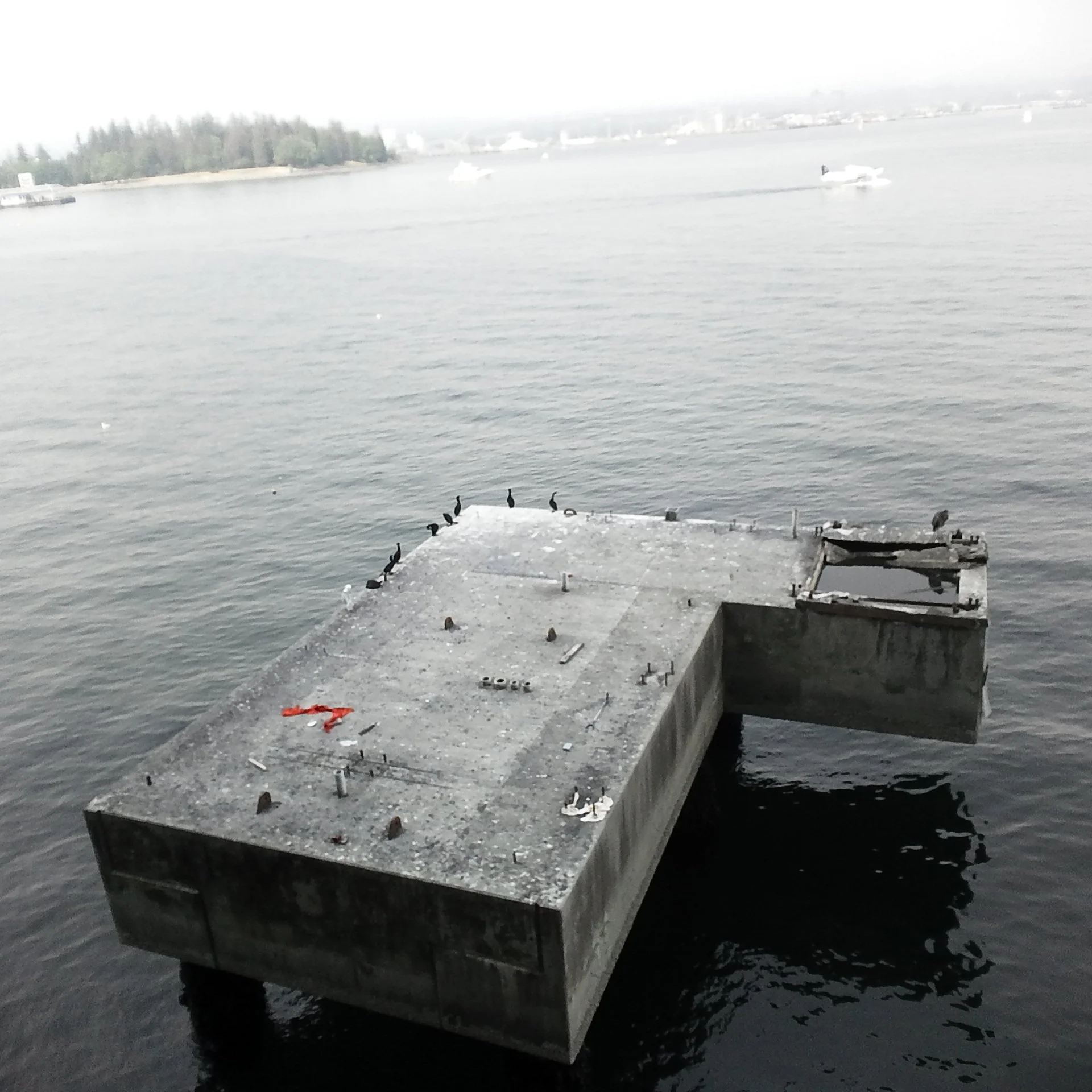
other birds are Pelagic cormorants. Off in the distance, Stanley Park. Happening upon this construction by the Vancouver waterfront, my friend Paul Endo and I both instantly reached for our cameras, him first. (I met him when we both started doctoral work in Toronto, he working on the sublime in Shelley and Stevens, me on the short fiction of Donald Barthelme.) What makes this image a fragment is the haphazard, randomly occurring red cloth in the lower left of the shape, stationary, unlike the birds or the speedboat creating a spray in the upper right of the photograph. Nor to forget the reflections, slightly rocking in almost non-existent waves, subject to change, yet always obeying the same laws of physics as they form and reform.
*
The American pelicans are going to disappear from the creek soon, but should return in a few months before heading south for the winter. Their wingtips the colour of the four crows chastising an unleashed dog in the park. A woman eating an ice cream cone just rode past on a bicycle. And then a father goes by explaining evolution to his youngest daughter who’s riding shotgun on his shoulders.
—Diary notes: June 4, 2010
*
Dürer died from a fever he caught in a Dutch swamp, where he had gone to look at a stranded whale.
David Markson, Wittgenstein’s Mistress
*
After years of renting a house in a rough neighbourhood in Regina, my second wife Amy and I finally bought a small house in one of the more beautiful areas of town. The new tenant of the place we once lived stayed only two months because she came home one evening to find a noose hanging from a beam in the basement. The worst that happened to us when we lived there was a broken passenger window on our old car (the car’s owner’s manual stolen, according to the police, likely an initiation rite for membership in a gang) and one night our recycling was stolen from the garage. But inside the rental, very often life was lovely. Amy turned 30. I would become her husband a short time later. We took any number of photographs. Bought a massive antique stove for furniture, gathered pets. We were prose poems curious about what we might find inside narrative.
*
One keeps meeting the world-as-non-sequitur through an assemblage of randomly construed facts:
—That one of the greatest joys in my life was seeing a pair of Pileated woodpeckers on Cortes Island, a place I first heard about in an Alice Munro story.
—That I buy new shoes once every three years: Blundstones, once made in Tasmania, but now in Asia.
—Early onset Alzheimer’s. The malady my (now deceased) dentist didn’t know he had, making him unable to detect advancing bone loss in my jaw. Implants were very expensive and only a small amount was covered by insurance. I chose to proceed with the periodontal work anyway.
—That I own many, many large scrapbooks in which I keep a bestiary of bizarre news items.
Eliezer Eisenschmidt, a member of the Sonderkommando (the Jewish prisoners forced to remove corpses from the gas chambers at Birkenau) recalls a particularly gentle comrade “who was very sensitive and took care of the bodies of murdered children only. He’d evidently been a teacher or a writer. He looked for children’s bodies only; he went into the gas chambers, and pulled out their bodies. In our jargon, a baby was called a piccolo and that became this Jew’s nickname. No one knew his real name. We always called him Piccolo. He’d pick up the bodies and carry them to the pit or the furnaces.
Testimony from Eliezer Eisenschmidt, We Wept Without Tears
— I was going to my night shift in the grocery store when John Lennon was shot on Monday, December 8, 1980, the news on the car radio around 10 o’clock.
It was snowing.
Basri. The surname of an Indonesian Communist political prisoner on whose behalf I (and others) repeatedly wrote letters to Indonesian government officials. On a typewriter as a member of Amnesty International when I was fifteen. Listening to Lennon’s post-Beatles music made me feel I should do something about things that were happening in the world. But the Vietnam War was over and besides, I was Canadian. I decided to join Amnesty. Now I sign online petitions with merely the click of a mouse. Has the reader seen the 2012 movie The Act of Killing, directed by Joshua Oppenheimer and co-directed by Christine Cynn and someone whom Wikipedia identifies as an anonymous Indonesian?
—The elderly man whose family believe (but can’t prove) he molested several children. Beginning with a friend of the birthday girl at a swimming party. In his late 70s, being treated for a particularly lethal form of cancer, he’s going to lose his teeth because of radiation treatment. His memory is shot. When he dies, only his victims will know for certain what actually occurred. Facing his youngest daughter for the first time since his diagnosis, he opened his hands wide and remarks: “Look at what I’ve come to!”
The intimate cynicism of the world.
*
I’ve read Proust’s In Search of Lost Time 3X; I’ve read Anna Karenina 3X as well because I suspect it’s Alice Munro’s favourite novel. Wallace’s Infinite Jest twice. Musil’s Man Without Qualities once, ditto Karl Ove Knausgaard’s My Struggle, some of Zadie Smith’s essays but not a line of her fiction. Of all the Toni Morrison novels I’ve read, Jazz speaks closest to me.
She turns Hegel into a street busker.
It took me about 9 weeks to read the Knausgaard from start to finish, whereas to do the same with Proust (with whom KOK has been compared) takes me the same number of months. I do know what this says about the two writers, but I don’t know what it means about our times.
2/3 of the bookcases behind me were curb-snatched.
*
A mature Anna’s hummingbird hovers near the sugar water feeder; an exceptionally combative and territorial creature, it will chase off and then pursue a competitor with the dexterity of a heat-seeking missile. Its tongue resembles a thin spray of water that is also a sticky strand of a spider’s web. I can hear its wings whirring, but not the vocalizations she makes, audible to Amy and Jakob, a reminder that my worsening hearing is blotting out parts of the world as I age.
*
Schadenfreude—whose sudden and immediate arrival is the vice for which I most revile myself.
*
Alex Trebek died not so long ago. Let’s play Jeopardy.
Answer: Flimsy.
Question: How characterize my understanding of world history? (See Pankaj Mishra’s deconstruction of the basic historical and philosophical knowledge shared by both progressive and reactionary white intellectuals in “Grand Illusions,” an essay published in this week’s The New York Review of Books.)
*
Jorie Graham’s Fast. No lines more full of emptying. Except Dionne Brand’s.
*
Montage: implacable: mysterious. And is it only a matter of time[4]
To be born into the ranks of the Filipino poor is to be condemned to the fatalistic knowledge of perpetual hardship and the dangerous futility of seeking improvement. Landowners dominate local governments, while deploying private armies to keep control.
Peter S. Goodman, “A Promise to Philippine Farmers Can Kill Them,” NYT December 29, 2019.
*
Not all spiders make webs.
Sentences with built-in memories.
Don DeLillo, Mao II
A definition of metaphysics:
My eldest son, then aged six: Dad, I’d like to try being someone else. I want to be other people. I could even be a piece of furniture.
*
As a child I collected trilobite fossils I found with a small hammer and chisel, tools I bought with my allowance; I wanted to be a paleontologist when I grew up. Years later, walking along Hadrian’s Wall, I wanted to become an archaeologist. In high school, my ambition was to head to Japan after graduation and study Zen. Now I find myself a late middle-aged English professor in a small university in the middle of Canada’s prairies.
My father’s a snowbird who winters in Florida. He’s likely one of the luckiest people to have ever lived. Born in Canada in 1939, his father was too young to have fought in the First World War, too old for the Second. Dad believes in reincarnation and maintains that when he’s travelled in France that he’s recognized villages in Normandy from hundreds of years ago when he used to live there.
That I suspect nothing coincides with anything, especially itself, and that I will never detect what’s behind all the hidden staircases that have brought me here.
—for Don Coles, 1927 - 2017
from The Sunday Book
[1]It concerns me that this desire to educate myself about the Holocaust may have a psychological origin, rather than being an honest attempt to recognize what happened, to respond to the claim it has upon us. Christopher Bollas argues that individuals may seek out aesthetic moments that entail “an uncanny fusion with the [transformational] object, an event that prevailed during early psychic life. However, such occasions, meaningful as they are, are less noteworthy as transformational accomplishments than they are for their uncanny quality, the sense of being reminded of something never cognitively comprehended but existentially known . . . . It is well to remember that an individual may seek a negative aesthetic experience, for such an occasion `prints’ his early ego experiences and registers the structure of the unknown thought. Some borderline patients, for example, repeat traumatic situations because through the latter they remember their origins existentially.”
[2]Part of the psychic whole that infuses Gabriel’s self-understanding (and the epiphany in Joyce’s “The Dead”) is that he’s ignorant of contingency: it is only by chance that Greta is reminded of her teenage love. It is an open question whether Gabriel will be able to throw off the weight of his relentless self-absorption when he and his wife wake the next morning to a snowy Dublin.
[3]On the question of mind-independent reality and gestalts, Zwicky writes: “Since we and other beings demonstrate the capacity for accurate gestalt perception in a wide variety of situations, evolutionary theory suggests that such a capacity must be adaptive; if the capacity is adaptive, what it registers is real; ergo, gestalts must be mind-independent. At least they are as mind-independent as it gets. How mind-independent is mind-independent reality? No physicist or philosopher has been able to propose a fully satisfactory answer to this question . . . . I propose to leave it open.”
[4]until the future’s splintering doppelgänger somehow appears posed in a hidden Bavarian bathtub? See the photograph taken of Lee Miller in Hitler’s bath in 1945. Carolyn Burke writes: “In the most telling irony in a photograph full of ironies, Lee saw herself both in Hitler and the statuette—which recalls her modeling career and role as muse for Man, Huene and Cocteau. Having placed this miniature Venus, armed but cut off at the knees, opposite Hitler’s portrait, she turns toward her counterpart, whose raised right arm echoes her own. This sly jab at cultural clichés about the eternal feminine is complicated by Lee’s knowledge that as a blue-eyed blonde, she met Hitler’s aesthetic standards—which concurred with the prewar period’s return to classicism. This rapidly composed scene includes her recognition that she would have been considered an Aryan, one of the hated `Krauts.’” (Carolyn Burke, Lee Miller: A Life, U of Chicago P, 2005. 263.)