
In his essay “Remembering Apparatus,” Don McKay observes that “It is one function of art to provide safe defamiliarizing moments, when the mask of utility gets lifted and we waken to that residual wilderness without the inconvenience of breakdown or disaster.” I’ve always taken this insight to apply to an audience’s consumption of art; a recent movie like Backrooms or Helen Phillips’s novel Hum, for instance, allows an audience to get close to the edge of the violence neoliberalism inflicts upon people—but we don’t personally experience either a psychotic breakdown or the desperate choices penury and precarity foist upon the vulnerable family in the novel. This doesn’t mean that the moviegoer or reader of the novel hasn’t been personally crushed by mental illness or be in the position of having to decide between meeting a variety of expenses and providing healthy food for one’s family. McKay doesn’t ignore these difficult realities in his work but in this observation, he points to the possibility that art allows us to imaginatively encounter any number of difficult circumstances and emotions we would avoid in actuality. For him, art can be an epistemological tool that has a safety valve. It is a version of the sublime.
What interests me here, however, is whether one might turn McKay’s (admittedly somewhat Aristotelian) claim about art offering a sheltered way of encountering calamity away from the reception of art to its creation: that is, do some artists compose their work in an effort to offset hardship, especially when it concerns the problem of futural adversity? By this question, I don’t mean to ask whether composition is therapeutic in the way May Sarton notes in her journal Recovering: writing “is the only valid medicine against the flu, old age, depression—so here I am.” While I don’t dispute Sarton’s sense that writing can help one to cope with suffering, my question is more whether some artists compose with the aim of articulating fears of specifically futural events as a means of reckoning with them from the vantage point of safety. Jorie Graham’s recent To 2040 comes to mind: the book opens with the question “Are we extinct yet,” though notably she doesn’t use a question mark, ending the sentence with a period and more pointedly posting the question by splitting it up between title and first words of the poem:
Are We
extinct yet.
Framing the question like this makes it detonate. The hugely tentative and vulnerable “are we” lands on the announcement of an inevitability. Also, it isn’t clear whether we refers to the species to whom the reader belongs or, as readers of Graham will recognize, the we could refer to anything living or even a form of technology. It’s unlikely this technique serves as a protective talisman that, by announcing dread, will prevent calamity: the poem can prevent no extinction. It may, though, seek to create an ongoing readiness for as yet unexperienced trauma.
As mentioned in this website’s Cancer Blogs, one of the first things I’m encountering is how cancer memoirs I read several years ago are much different post-diagnosis. When I read Jenny Diski’s In Gratitude in 2016 and came across the passage below it spoke to me because of my GAD (Generalized Anxiety Disorder):
“I will continue to live with uncertainty, and my inability to do anything about it, the condition I’ve been trying to wriggle away from all my life.”
I instantly recognized the life-long struggle to escape uncertainty, but now, waiting for a CT scan to be scheduled, a procedure that will determine whether cancer has spread to other organs, I now find Diski’s remarks to go very deep. Imagination initially permitted me to explore Diski’s rejection of uncertainty only slightly because I read the passage as a healthy person, though I shared her understanding that, from childhood onwards, uncertainty was an ongoing debilitating enemy. And now, post-diagnosis, I also use imagination to get closer to what Diski was experiencing. What’s important to this blog is that Diski wrote her memoir after her diagnosis, and this is different from what Graham is describing: a futural disaster.
Can poetry be a prophylactic of sorts? Yes, and no. An important part of what McKay says concerns his linking art to “residual wilderness,” a position that links him with Gary Snyder. Referring to Claude Lévi-Strauss, Snyder writes: “the arts are the wilderness areas of the imagination surviving, like national parks, in the midst of civilized minds.” An unruliness, then, and something different from the codification and acquisitiveness of civilization, presents itself in art. And as Robert Bringhurst puts it, “the wild is everything that grows and breeds and functions without supervision or imposed control.”
It took a few weeks after I was informed of bladder cancer that I realized that many of my earlier poems manifest a tentative probing that blends fright with prophecy, posed through questions. Here’s one, from Realia:
What Is
the collective noun for folks living one
day away from what they most fear? In how
many languages can you convincingly
learn to laugh? Open your skin to wet
bulb heat waves performing mise en scène? Just in
today: even Arnold Schwarzenegger’s a fan
of Seneca. Just
landed. Here at last. Wow, there
are these amazing connections reappearing
people once made. If I see
you later, baby-talk
something inscrutable to me:
spool-y-spin
deliberate reincarnation, cute money-mingling, socially-
sequacious whale-and-squid-watching, the safe &
sophisticated bits. Beget order, beget
the self-evident. Picus viridis. The laughing
European woodpecker. Mischief. All of
the above,
aloft. The diagnosis. The fold-out
cot in a gymnasium. Everything else
gone. Aphasia. Listen. Genres
vivify
a need for which no alternative method exists.
If we don’t have a precise nomenclature for those terrors people have of conditions not yet actualized, I suspect that most people have an ongoing fear that something they most dread will, in fact, transpire. The question is tricky, because fear rivets the self to the self, yet there are collective fears: the poem later offers the singular “diagnosis” or communal
the fold-out
cot in a gymnasium. Everything else
gone.
This poem appears to be mourning something that hasn’t yet transpired to the speaker(s) though of course millions of people today are confronting a diagnosis and relocation. Does the poem wish to engage magical thinking? Does the poem hope that naming a disastrous event will forestall its occurrence? I honestly don’t know because even though I wrote this poem, it has an existence separate from me. What I do observe, though, is that the poem clutters its way into a type of wilderness:
If I see
you later, baby-talk
something inscrutable to me:
spool-y-spin
deliberate reincarnation, cute money-mingling, socially-
sequacious whale-and-squid-watching, the safe &
sophisticated bits. Beget order, beget
the self-evident. Picus viridis. The laughing
European woodpecker. Mischief. All of
the above,
aloft.
Wilderness means not simply a reference to animals—whale, squid and European woodpecker—but an out-of-control zaniness. I wrote this poem several years ago, and I hadn’t realized how the poem jostles back and forth between the private and the communal. The Squid Game meets the horror of an individual suffering aphasia. And there is no genre for this tension. Illness has shown me how privacy collapses. To have a catheter removed means to lie naked on an examining table in order for that blessed nurse to get you to breathe and then this saint, whom you’ve only met minutes before, tugs on the tube removing it. I’m not overly shy about nakedness, but.
Here’s another poem, this one from Whoosh:
Now What
It’s all behind us the suspense which happens
all the time. Get back here I know we have
a lot to talk about. It’s another world. We need
to know what you know. The special clothing you
wear for melancholy. Vulnerability. What you
repress from their cradle. From the orange of
persimmons flown from Spain. Daylight reveals
its jamboree of statistics. Fuck, the can opener’s
broken! The almost sightless food that can read
your thoughts. And what, actually, is dignity?
What happens next is the unconscious desire to play
with fire. The posthumous retrial. The posthumous
addiction: a shaft of sunlight wanting its palm read.
Is this sort of poem a deliberate / unconscious desire to play with fire: what happens when there’s only canned supplies and the can opener breaks? A fear that’s repressed from the cradle is what you get. Anne Simpson notes in “A Hundred and Fifty Psalms at Twilight” that “poetry exists somewhere between order and chaos, thriving on both, sometimes providing an orderly sequence, sometimes giving us mere flutterings of thought blown around the page . . . it is instant and era.” If part of “Now What” is an unanswered question that springs from a neurodivergent presence that often feels objects have the capacity to your mind, it is also wilderness. It isn’t as though waving a poem like this around in the persimmon-orange smoke in the air (or for that matter, waving around Graham’s last few books) can head off collective and personal emergencies. My only claim is that, if I’m continuously reassessing my previous reading because of cancer, I’m doing the same with my earlier work. The poems aren’t clairvoyant, though they are rebellious. It’s just weird how they read now.
I can’t help but think that these sorts of poem are a primitive, even psychologically primordial response to anxiety, and here Freud is useful. Observing a toddler in a playpen tossing a toy attached to a string away from himself and then pulling back towards him, all the while uttering a sound he made when his mother went away and then “da” (there—thus the fort / da activity), Freud reasoned that the child was attempting to compensate for loss by making a game that re-enacted his anxiety, but with a twist. Rather than being marooned by his mother, the child was able to assume a degree of agency so that he was, as Freud says, able to take “on an active part.” This episode from Beyond The Pleasure Principle has obvious implications for the creation of art as many have observed. The root of narrative is to reconcile loss. I note, though, that the situation in which the child created and resorts to the game take place in the present. It seems that some of Graham’s work and the two poems of mine I’ve included above, might have at their core a version of the fort / da game the toddler devised. Impossible to say, because they also manifest the wilderness, a jamboree of incommensurate forces and drives, memories and visitations that is as much trans-species as cultural.
Watch Graham in her poem “Fog”:
Then the drone came. A small personal drone . . .
[It] was medalled with debris,
a tin castle, a wooden fish, a rattle—a miniature
clock w/one hand . . .
one eye a Milagro
hanging there sideways
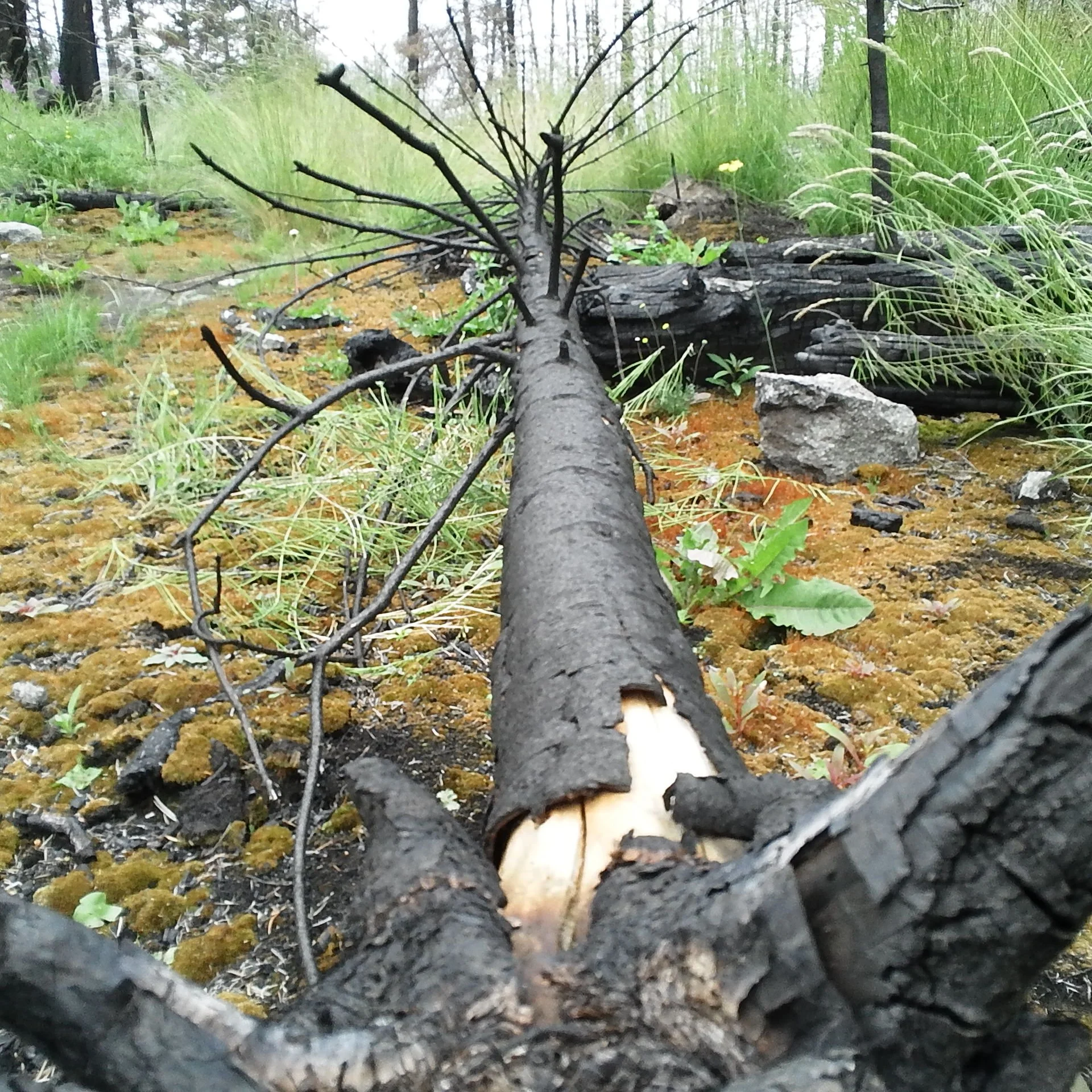
Burned forest, south of Jasper, Alberta 2026