In my ongoing efforts at grasping my impending divorce, I’ve found myself probing memories of the marriage, some painful, but many others gentle and as with most occasions during which one sifts through the past, patterns emerge that weren’t available to consciousness until much later. Yesterday I attended a so-called Celebration of Life for a former colleague, a playwright who’d eventually succumbed to Alzheimer’s. As part of the ceremony, a mutual colleague, Nick, long since retired to Ontario, offered a few remarks over Zoom. (I didn’t go to the service in person so I too attended virtually because I’ve been told I need to try to avoid being in crowded places; if I get sick I have to pause my BCG treatments.) I hadn’t seen Nick, a professor whose expertise was fin de siècle literature and sci-fi, for nearly a decade—he and I have visibly aged—and seeing him I remembered a dinner my-soon-to-be-ex and I once shared with Nick and his partner, the Swedish-Canadian writer Britt Holstrom at an Indian restaurant in Regina. The occasion was my then-wife’s birthday. Over the decades we’d given each other plastic animals, and so it wouldn’t have surprised her when I drew a beautifully made plastic model of a Bengal tiger from my pocket—the creature with one paw raised in warning—and nudged it in her direction when the first plate of Naan arrived. I was being playful, pretending that the tiger was about to seize the food.
I hadn’t thought of this occasion that took place a number of years ago until I heard Nick’s voice and once again took pleasure in his Manchester accent and eloquence. (He’s since taken up amateur acting in Ontario where doubtless he’s charmed many audiences.) But here’s the thing: I’d chosen to give my wife a Bengal tiger as a kind of visual pun—we’d made arrangements after all to dine in an Indian restaurant—but yesterday a deep memory stirred, this one from my very early childhood. I would have been about five and my young parents (in their mid-twenties) regularly made a trip to Detroit along with another young family for the weekend. It was during these trips that I discovered how strange grownups were when we kids would wake up in the motel suite while the hungover adults slept and we would nibble on the left-over pizza and sniff the alcohol left in the glasses. Beer smelled awful and scotch smelled of slumbering burlap. Later we’d make a trip to the zoo and once we entered the dank building that held tigers. These miserable creatures had their outdoor dump of rocks and sparse grass but on this occasion one had come inside and he paced alongside me while I walked the length of the large room. I can still sense the tiger’s presence today and my mom told me that the tiger wanted to eat me. What I recall isn’t the five-year-old being frightened by the creature—I was cautious, certainly—but what I felt was an immensity of strangeness that issued from the moving tiger and also the humidity of the building. I knew about pets because my family had a dog and a cat but I suspect that it was this encounter with a species I’d never seen in real life before that revealed something about the foreign nature of animals (perhaps accentuated because I also knew that we were in Detroit, a city in another country). My family and this other one (the father would die decades later of systemic scleroderma, a fact that unnerved me when my own scleroderma, fortunately not the systemic kind, appeared) made the trip to Detroit twice, I think, but then racial violence happened and my parents felt it was no longer a safe place to visit. What I understood yesterday during the service was that my action of buying the tiger from the toy store we frequented back then to give to my wife was, on one level simply some silly fun, but on another level that child, now in his forties, wished to share with her the precise sensation of that little boy taking in that huge predator as we both walked parallel to each other,
As an adult I feel that caging tigers is a moral travesty. Its life must have been a deranging chore. And I’m ashamed that my family wasn’t aware of the suffering that African Americans faced not only in Detroit, but the rest of the United States. My parents had the capacity to know about these people but I think their attitude to American politics was that it didn’t concern us. All I can say now for and about that five-year-old is that he was occupying for the first time that weird, nearly trembling place in which beauty slips into the uncanny. It was this blurred sublime that I was actually offering my wife, though I didn’t understand that as we ate the Naan, tandoori chicken and okra. A small gesture that embodies how multi-dimensional love is and how we can’t seem to comprehend the depths of a given present moment. As I’ve said elsewhere, the present is a glue to which nothing sticks.
. . .
Beauty can be dormant for decades, can participate in a kind of Nachträglichkeit but it can also, as Elaine Scarry notes in On Beauty and Being Just, suddenly appear and when it does: “At the moment one comes into the presence of something beautiful, it greets you. It lifts away from the neutral background as though coming forward to welcome you.” Moreover, Scarry argues that when we encounter beauty ‘it seems to incite, even to require the act of replication . . . Beauty brings copies of itself into being.”
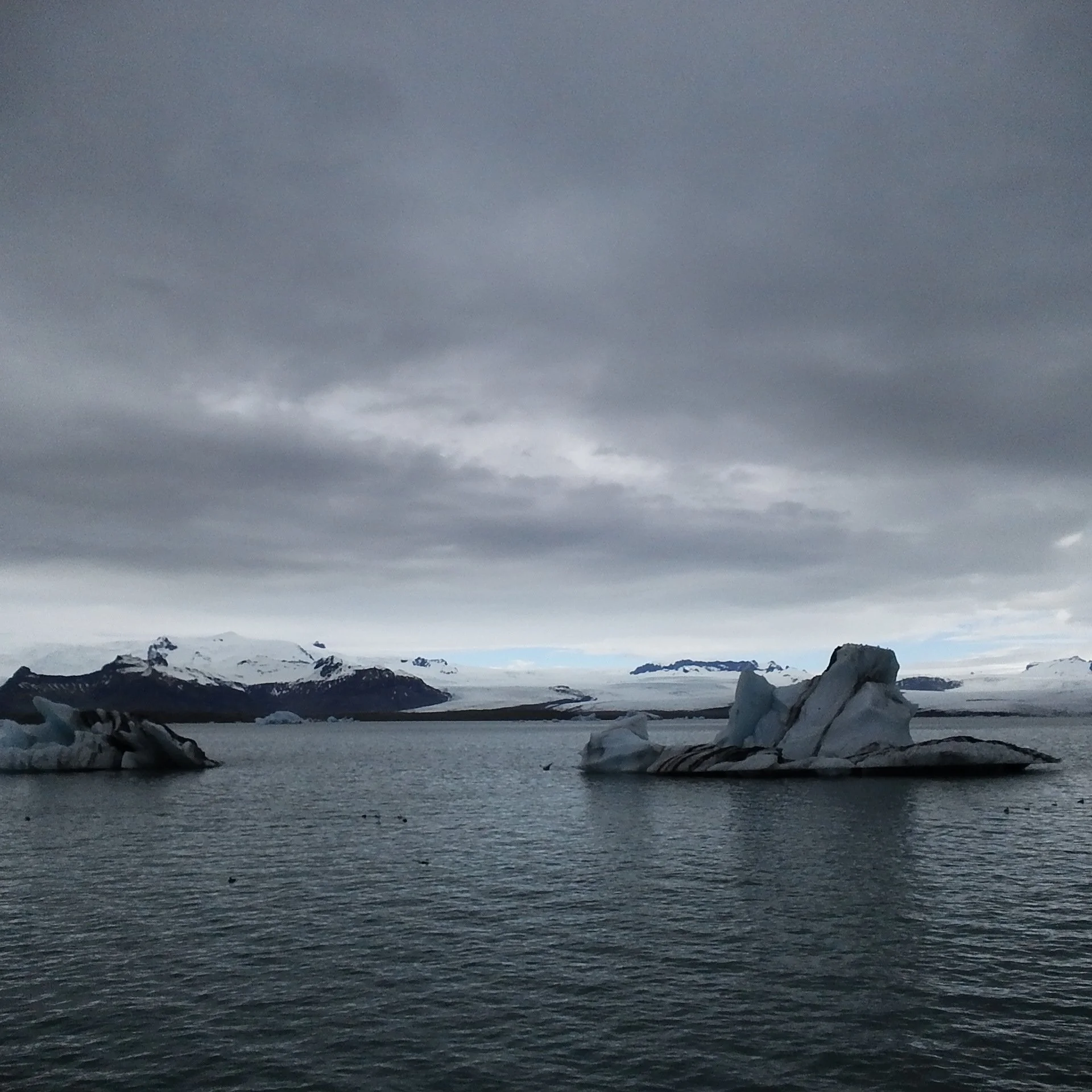
The most beautiful natural phenomenon I’ve experienced in years is the Jökulsárslón Glacial Lagoon in southern Iceland. I cannot replicate it, yet the urge to do so is strong. Along with the other tourists I took photos of the various colours of ice, water and cloud; and now I’m writing this blog post. While walking from the beach to the lagoon with my youngest son, both of us wearing our binoculars, we slowed our pace because we noticed a few snow buntings in the bushes and on the rocks. One way of replying to both Scarry and the lagoon is to offer that pausing to watch and listen to these birds brought everything together. It was as though the song of the bird we got closest to was a point that drew together and collected everything within view in the external world and everything inside. The glacier in the distance, the eider ducks in the water, the various bergs and the grey sky, our joy and excitement at finding ourselves so far from Saskatchewan in this utterly new landscape—all of these colours and histories converged in the song the snow bunting made. It held us together. My ASD felt the entire scene was glowing with sentience and it seemed that for as long as the bird sat on the bush and lifted its head to sing, we were all creatures meeting in that sound.
I won’t go so far as to say that this small black and white bird, a kind I’d never seen before, was greeting us, but it was greeting and welcoming something into that moment of being precisely there. And we were fortunate to be on that gravel trail to encounter that specific bird, to see the freshly calved icebergs, each of them made of ice approximately one thousand years old, ice that chilled the air. Inside a near infinity of objects and life-forms—from the jeep-boat that took us tourists closer to the bergs themselves to the cell phones we all used to the black-headed gulls overhead and seals diving for herring that we couldn’t see—amidst all of this, the snow bunting’s singing was a kind of metaphysical plumb line that was alive, alive, alive. Let me try this another way: I didn’t know that the reason I had to piss so often on that trip was my bladder cancer. I’m utterly grateful that I didn’t know this fact because it would have blended into the joy my son and I shared that day. If I can still manage moments of happiness now several months later even within this knowledge of cancer, I feel blessed that we were able to open ourselves to those astonishing forces in the lagoon without the disease’s presence: we simply spent some time nearby the ancient ice, luxuriated in our being able to breathe the same air as the snow bunting, the closeness we had in making the trip together by ourselves. We never spoke about the breakup of our family. Instead we were two birdwatchers on a three-day excursion in southern Iceland. The snow bunting was the bird that meant the most to me. For my son, it was the flock of Great Skua floating and darting on the cliffs overlooking the black beach at Vik that most thrilled.
. . .
In The Logic of Sense, Gilles Deleuze offers a challenge when he writes that we must
become worthy of what happens to us, and thus to will and release the event, to become the offspring of one’s own events, and thereby to be reborn, to have one more birth, and to break with one’s carnal birth—to become the offspring of one’s events and not of one’s actions, for the action is produced by the offspring of the event.
Difficult stuff. Difficult in ordinary life, but even more so when going through a marital collapse, and treatment for cancer. I don’t know how to become worthy of what’s happening. It’s much easier to perseverate through a murk of negative emotions, specific fears about the unknown, yet threatening future. Deleuze’s point is also hard to unpack at the level of idea—how to separate events from actions?—though this is, I think, the way into what he’s getting at. While we can make choices that result in actions—I pushed the plastic tiger towards my wife on her birthday—even if we don’t really grasp all that impels us to make certain actions, what seems to be more crucial is to slow down to the point of stopping everything and take in what’s here. It took planning and then a long journey through various airports and down roads in Canada and Iceland for my son and I to get to where we could see ash on glaciers from the 2010 eruption—my son less than a year old at the time—but these actions aren’t quite the “events” to which Deleuze refers. What I think he means is that I should somehow stop scrambling away from what hurts, what can invite Nietzschean ressentiment and allow the memory of a long dead tiger to coincide with the great gift of my son turning to me while were in Iceland and telling me that he couldn’t imagine being there with anyone other than me, and to let all of these myriad things sift into me as I lie on the hospital cot in a few days, and ready myself for the uncomfortable insertion of the catheter that will permit the nurse to conduct the BCG treatment. But I don’t know. I don’t think I’m capable of being “reborn” in any meaningful way. My sense is that I must make the effort to react less to what’s disturbing me because this impossible to grasp web, network—whatever metaphor one might choose—is bigger than what occupies my immediate concerns and multiple weaknesses.