
I’ve loved Rothko since I first encountered his work in the Tate in 1995 when I was in London with my first wife, Lynn. Those were lean times, and Lynn had suffered her first miscarriage. I had a term contract, so no stable employment, but managed to get an extra course teaching in the spring, so we decided to use this unexpected money to go to London and then Paris, places she’d never been but yearned to visit because she’d studied Guillaume Apollinaire and was doing her PhD in contemporary British fiction. We were in our mid-thirties, confused with each other, and very much in need of getting out of our cockroach-infested apartment above a health food store on Jane Street in Toronto. At that point, we’d been married for a decade, and I’d just been diagnosed with clinical depression. It would be decades until I learned that this depression and corresponding substance abuse were most likely me medicating myself for an undiagnosed learning disability and ASD. To discover Rothko and then some installation work by Christian Boltanski in the Tate was to be momentarily released from the turmoil of that summer. Teaching had been very difficult; my mind often stumbled in its own slush, forgetting names of characters, torpedoing my vocabulary . . . and this combined with my incapacity to help Lynn feel better made that brief time away something of a respite.
. . .
Rothko’s work opened a space inside me that no other painter had done and when I learned later about his mental health problems, alcohol addiction, and suicide, I had a sense of why his colours became a dark cave lit with feelings I felt welcomed ↔ compelled to explore. This past October I was lucky to be able to spend a fair amount of time in a small room at the Art Gallery of Ontario that held this single painting. No. 1 (White and Red), painted in 1962.
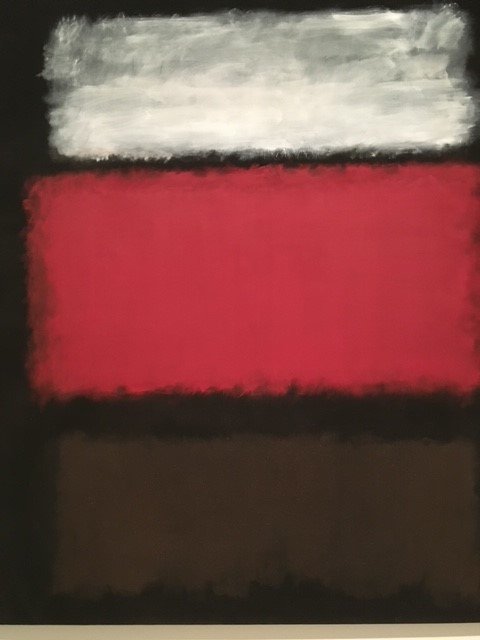
No. 1 (White and Red), 1962. Art Gallery of Ontario
People would drift in and then leave the room, a few individuals and couples took selfies in front of the painting, and I, equally but differently self-absorbed, stared into the painting and understood that Rothko’s rectangles grasped my autism deeply, so deeply . . . entirely unlike the amazing colour-fest of the Gerhardt Richter in the adjacent room. I adore Richter, too, though he is liberating rather than penetrating if you can go with the distinction.
Stared at the painting, yes, and gazed, but these words are only approximations of the various ways one looks into a Rothko. English doesn’t have enough words for what one does with one’s eyes when alone in a room with a painting such as this one. John Berryman once quipped that a poet is a person sitting alone in a room trying to make the English language work. Fair enough, perhaps his contemporary, Mark Rothko, was someone who spent weeks pondering a blank canvas to then discover what colours can do.
(Not if they “work” as Berryman suggests of words, because colours don’t obey anyone.)
You don’t simply sit, of course. You get close, take off your glasses if you’re myopic like I am and follow the storm-threads of one rectangle shifting into the one nearby. You take in the painting from different angles at varying distances. An hour passes. You return the next day. Initially, the mind begins to associate freely, tumble from one memory to another—deep childhood, the person you noticed on the subway scrolling on her phone only an hour before, the other Rothkos you’ve seen. Memories of powerful lust, next to a harsh wind from the north, so strong it blew the falling snow in a horizontal wave across the parking lot your studio apartment overlooked, the one you lived in after leaving Lynn and your two impossibly young children. But then it comes, that gift that Rothko offers when you’re patient enough to wait: subjectivity vanishes. It just goes. Memories stop arriving, plans for the evening, everything disappears except what’s in front of you. Except it’s impossible to know, let alone say, what’s there in the room. It’s as though the scurrying mind, flitting from thought to association to registering a scattering of emotions, stops. You can feel the mind slow, come to a gradual stop, not a collapse, but a cessation of movement. And then it, the painting, your sense of it, barely breathes, though breathe it does, breathing in colour and then whatever it is that’s beneath colour. Quiet. Not mute, perhaps silent.
. . .
James E. Breslin’s biography of Rothko contains this:
So `to those who think of my pictures as serene,’ Rothko asserts, `I have imprisoned the most utter violence in every square inch of their surface.’ Reacting against the reduction of his paintings to the all-too-bearable, Rothko’s polemic exaggerates both their violence and constraint. . . His art opens a window on a Dionysian violence which, in the confinements, distractions, and hypocrisies of daily life, necessarily stays firmly shut, with the blinds drawn.
Fair enough, but a “window” suggests an inside and an outside. The slowing down of mental activity to which I refer collapses this binary. Something happens—call it primordial or preverbal or whatever other descriptor comes along—but something happens that operates outside of any notion of interior versus exterior. Instead, a hum.
I sense that this state is what my autism recognizes in Rothko. This painting was alive, was alive before the museum opened and would continue in the dark when night arrived, and the gallery emptied of people. Its white, red, blacks and brown are separate colours but also the same one. There’s nothing more red than this red itself. Or white. And what’s sentient between them. Autism feels ancient, so ancient—sure it can make the autistic person lash out in momentary and long-lasting confusion—but what’s there is beneath the present, what lives past the present, what exists apart from the present. It’s a bit like being imprisoned but not contained by walls or anything constraining; better, it’s a solitude that bores a hole in the air. And then like a mirror reflecting a mirror it just keeps getting deeper and deeper, the hole that you fall into and are ejected from in the same instant. Autism is being seen when there’s nothing there.
Painting No. 1 (White and Red) isn’t alarming; rather, it embodies a sentience that is bordered not by fear exactly, nor unease (though these words hover nearby) but a hum of whatever grief is. And this sentience is an absolute singularity in a way no person can be. It sounds hyperbolic, but Rothko’s “colour field paintings” came into existence at a certain point in Rothko’s life, his discovery of this style, but they also announce that they’ve always been here. If Richter’s painting is exuberance incarnate, a non-violent explosion of what impels possibility, Rothko’s summons death as a fact.